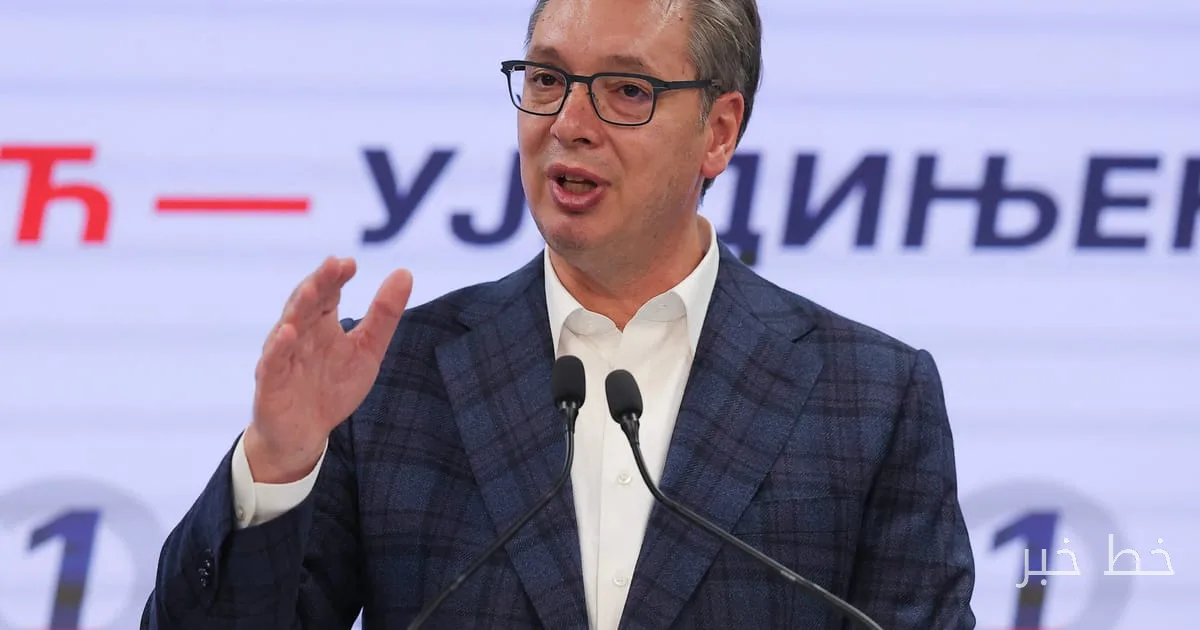
Aleksandar Vučić, the President of Serbia, announced the end of his 12-year rule on Sunday after important parliamentary elections that resulted in the victory of the student movement's protest list. Vučić told reporters and members of the Serbian Progressive Party at the party headquarters in the capital: "I want to inform you that based on a sampling, it is clear that we lost this election."
Election Results and Reactions
Vučić announced that the student list won between 135 and 140 seats out of 250 in parliament, while his own party secured 105 seats. After polling stations closed at 8 PM local time, the central election commission and election observers remained silent and did not publish preliminary results. An hour later, Vučić's sudden statement was broadcast simultaneously across all television networks in Serbia.
Upon the announcement, jubilant residents flooded the central streets of Belgrade to celebrate. One of the popular slogans at these gatherings was "Gotov je!" (He's finished), which was first raised 25 years ago in a similar election that helped topple Slobodan Milošević.
Social and International Implications
Ilija Srdanović, the leader of the student list, declared in his speech: "Never again to dictatorship in our country!" and told reporters that they are moving towards a civilized and better Serbia. Ursula von der Leyen, President of the European Commission, also stated after Vučić's resignation that the people of Serbia turned out in unprecedented numbers in this election to shape their country's future and congratulated the student list.
She added: "We are ready to support reforms in the areas of the rule of law, media freedom, anti-corruption, and strong democratic institutions and to work together for Serbia's progress in the European Union."
The voter turnout in this election was nearly 67.8%, an increase from 58.8% in the 2023 general elections. This increase reflects the high level of public attention and participation in this election.
Tensions in Belgrade were also clearly felt, with the main street leading to the central election commission blocked by metal barriers and riot control vehicles stationed in the city center. Raša Nedelković, director of the CRTA program, announced after the polling stations closed that for the first time in Serbia, access to the central election commission was blocked for voters.
Election observers from the Organization for Security and Co-operation in Europe (OSCE), the Council of Europe, and the European Parliament were present to provide an independent assessment of the electoral process in Serbia. Nedelković also expressed regret that members of the European Parliament needed police protection.
Vučić served as Prime Minister from 2014 to 2017 and then continued as President until September. Under his rule, Serbia was known for electoral autocracy, and there were significant criticisms regarding media restrictions and judicial independence.
Sunday's election marked the end of two years of protests in Serbia, which is considered the largest movement in the country's modern history. This movement began with the collapse of a train station roof in Novi Sad in November 2024, which left 16 dead.
Read more: Trump Could Not Change Economic Winds for Republican Candidates