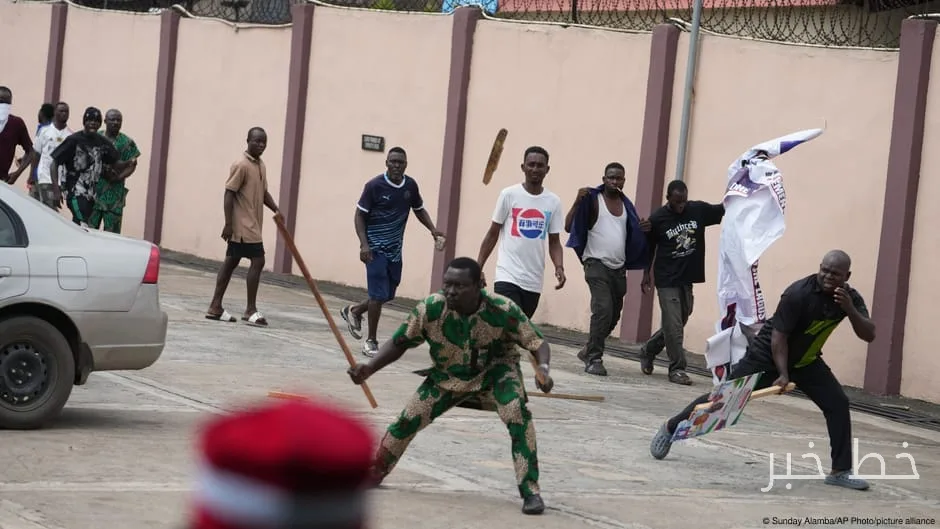
Samuel Adebanjo had gone to the Ogun area of Lagos, Nigeria's economic hub, to cover a public meeting organized by the opposition party, the National Democratic Party (NDC). However, this news assignment turned into a violent incident when a group of armed men attacked the venue and disrupted the gathering.
Adebanjo was photographing the entrance as people entered the hall when suddenly several buses arrived, and a loud noise was heard. He recalls: "Before I could understand what was happening, the men got out and began chasing party supporters with axes, pistols, and wooden planks, causing many to flee towards safety."
Read more: Problems with the Complaint Mechanism of the Asian Infrastructure Investment Bank
Injuries and Damages
Adebanjo ran towards the parking lot, hoping to find a place to hide. However, some of the attackers saw him and chased after him. The journalist, who collaborates with the local newspaper "Kabl," was surrounded by five men who began to beat him to take his camera. He said: "They wanted to take the camera. I was trying not to lose it, and in the process, my middle finger broke."
During the struggle, one of the attackers raised his axe towards Adebanjo's wrist. "I raised my hand to defend myself. I expected blood. I never realized it had hit my wristwatch, and at that moment, I realized they were not joking and I had to let go of my equipment."
While moaning in severe pain, he was taken to the hospital and found out that his middle finger was broken and he had internal injuries in his ribs. This attack also caused injuries to several others and damage to property, including vehicles belonging to party supporters.
Increase in Electoral Violence
As the general elections on January 16, 2027, approach, incidents like this are becoming increasingly common, while Bola Tinubu, the current president, faces challenges related to security and the country's economic crisis.
Adebanjo's experience is not an isolated incident. According to the National Peace Committee, 109 cases of violations of the national peace agreement have been recorded in 26 states of the country and the federal capital, Abuja. From August 19, when the campaign began in the country, until October 27, political and mob violence, along with misinformation, constitute the majority of violations.
Election rallies, public meetings, and other political events held by parties have been affected by violence, threats, and intimidation, and analysts warn that increasing violence could undermine the credibility of the elections and reduce voter turnout.
Civil society groups, including Amnesty International, have condemned the wave of electoral violence and intimidation across the country and have called on security agencies to prosecute the perpetrators of these attacks. President Tinubu has also criticized the rise in violence at political events, warning that intimidation and political mob actions that can disrupt public order will not be tolerated.
Political violence is not new in Nigeria; almost all elections in the country have been influenced by violence and intimidation. Recent patterns show that political groups are fiercely competing for victory in elections.
Read more: Inappropriate Responses from Two Officials to Disruption in FAA · Greg Stanton Announced the Return of DEI on Election Night