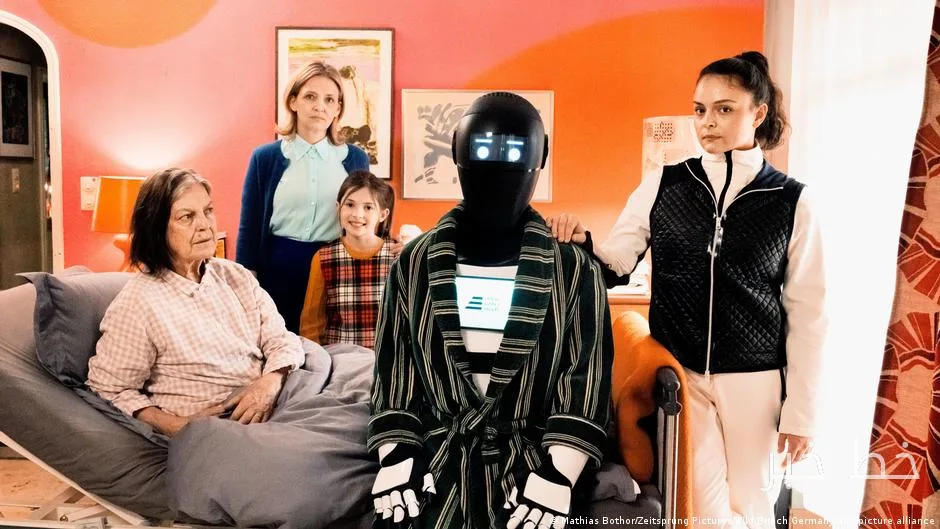
Doris Dörrie, with her new film titled "Ms. Winkler Leaves Home," explores the subject of caregiving robots and the human challenges associated with death and aging. The story revolves around an elderly woman who can no longer live independently after a fall. Since her daughter cannot care for her permanently, the solution seems simple: to use a caregiving robot programmed for dignified death.
Social and Ethical Challenges
This robot not only assists her in daily life but can also help her end her life under specific conditions, provided the individual explicitly desires this and meets the relevant medical criteria. Dörrie addresses significant social challenges such as the aging of societies in countries like Germany, Japan, and China, as well as the mother-daughter relationship, raising questions about guilt and responsibility. Although the story takes place in Germany, these issues resonate globally.
Read more: Lisa from BLACKPINK released a video of her preparations for the MTV awards
The Role of Artificial Intelligence in Daily Life
Dörrie discusses what happens when artificial intelligence begins to calculate the costs of caring for an elderly person and whether this cost is still "beneficial" for society. She references the Japanese legend of Narayama, in which older children are responsible for taking their elderly parents to the mountain and leaving them there because there isn’t enough food for everyone. Dörrie states, "This is also part of the discussion we are currently facing: Can we really allow elderly people to live longer and longer?"
In Dörrie's film, elderly individuals are allowed to make their own decisions when they reach a specific health condition, but they cannot change their minds later. She expresses that this issue is ethically complex, as individuals may be pressured to make decisions that are not only economically logical but also mean not being a burden on their loved ones.
Dörrie humorously raises these dark questions, and in one scene, a care consultant presents the option of dignified death to Ms. Winkler as an appealing and simple choice. Dörrie does not intend to demonize artificial intelligence; on the contrary, in her film, the caregiving robot, which Ms. Winkler names Pavlovich, helps her rediscover the taste of life and leave the house.
Dörrie emphasizes that despite the small homes across Germany and statistics showing lonely elderly lives, if artificial intelligence can help in these situations, why not use it? She states that she has explored this complexity in her film and finds the categorization of issues into black and white not only uninteresting but also incorrect.
Dörrie and her team noticed during filming how quickly people can form emotional connections with robots. She attributes this to the human brain. "We consider anything that moves and speaks to be a living being, and we cannot help it." She says this issue must be considered in our interactions with artificial intelligence.
Dörrie notes that the boundaries between humans and machines are increasingly blurring, making it essential to discuss this. She emphasizes that "things become problematic when we can no longer distance ourselves from technology and abandon our independent thinking." According to Dörrie, humans must ask themselves who we are and what truly defines us.
Dörrie also calls for regulation and oversight of artificial intelligence, referencing discussions about nuclear weapons, stating, "We must also move quickly in this area."
Read more: Hailee Steinfeld voices the witch in the animated film 'Hexed' · IMF Managing Director: Artificial intelligence will impact 40% of jobs worldwide