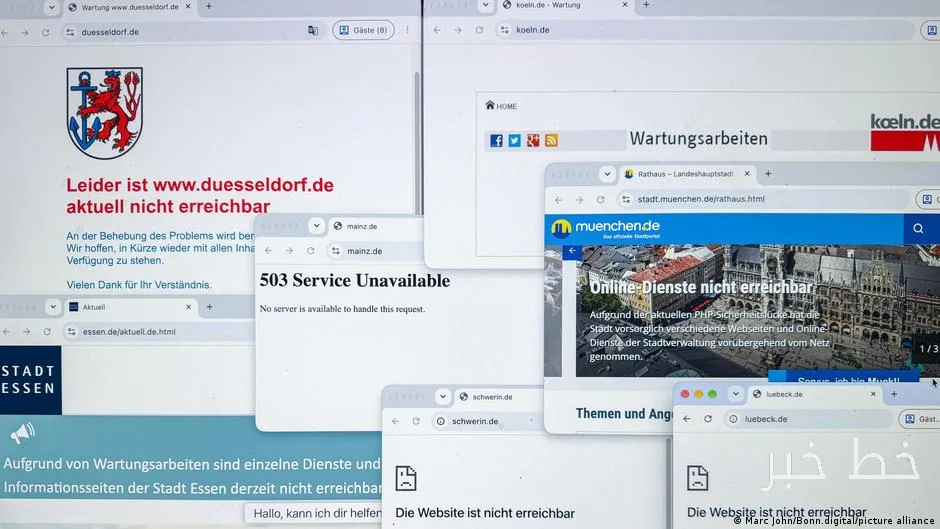
Several German public service websites were back online on Thursday, October 22, 2026, after a security vulnerability was discovered in PHP code used to power millions of websites worldwide. This vulnerability caused some websites to be taken offline as a precautionary measure.
Impact of the Vulnerability on Websites
After a warning was issued by PHP developers regarding the need to install a new security patch, public websites quickly returned to normal. However, some government portals, hospitals, and universities are still facing online disruptions, highlighting the need for greater attention to cybersecurity.
Read more: Freight train in South Africa sets record with 696 wagons
Warnings from the Federal Office for Information Security of Germany
The Federal Office for Information Security of Germany (BSI) warned of ongoing security threats and stated that hackers could use AI-based tools to identify vulnerabilities. BSI advised users to completely disconnect websites from the internet as soon as security patches are released to prevent potential misuse.
The office also noted that due to the existence of outdated software that is not easily fixable, ensuring the complete security of government, public, and private devices may take months. This issue could lead to increased security risks and cyberattacks.
Increase in Right-Wing Groups
Alongside these issues, a report from the German Ministry of the Interior shows that the number of active right-wing groups in the country has reached 20, up from about twelve in June 2024. The ministry stated that 2026 has seen a particularly significant increase. This issue has emerged following a parliamentary inquiry by the Green Party.
Right-wing groups have traditionally used martial arts and fitness to attract youth to extremist scenes, but the government has reported that martial skills among these groups have become significantly more professional. The report also mentioned the violent threats posed by these groups but noted that no direct confrontations with opposing groups have been recorded.
Growth of Battery Storage Systems in Germany
Germany is also rapidly increasing its battery storage capacity. According to a report from the Solar Industry Association BSW-Solar, the number of battery systems has increased by nearly half a million from January to September 2026. These new installations represent a 91 percent increase compared to the same period last year, bringing their total storage capacity to 8.2 gigawatt-hours.
Part of these new installations includes large-scale battery systems. The number of systems with a capacity of one megawatt or more has increased from 63 to 220. Batteries are recognized as a key component in the transition to clean energy, necessitating electricity storage to balance fluctuations. However, BSW-Solar emphasized the need to accelerate this expansion to meet Germany's clean energy goals.
BSW-Solar CEO Carsten Körnig stated that battery storage is becoming a growth and efficiency engine in energy transition and that this technology could save billions of euros in costs.
Read more: Trump is going to Ohio for the third time next week · The Department of Homeland Security removed DeepSeek products from government systems