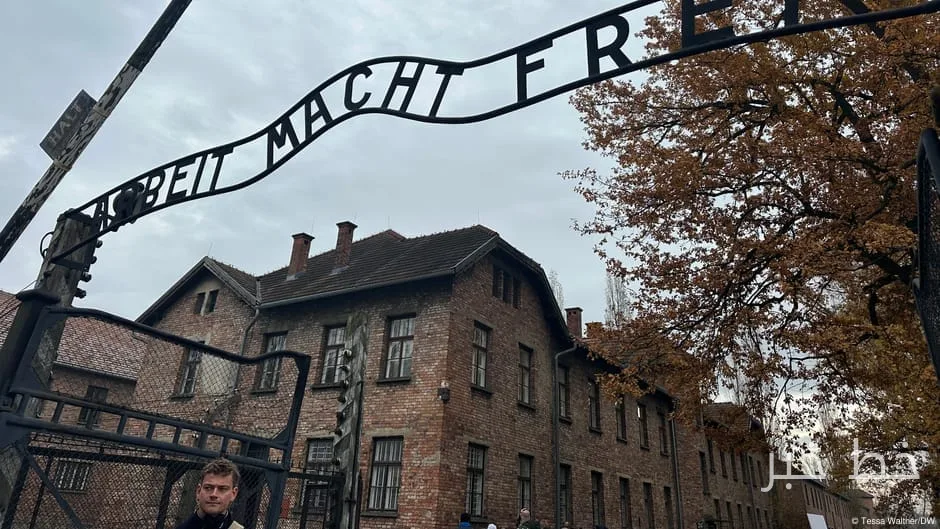
Regina Slozney passes through the iron gate that marks the entrance to the former Auschwitz camp in her wheelchair. This 87-year-old Jewish woman says, "I feel the cold, both physically and emotionally." She gazes at the gray horizon.
She estimates how many times she has come here? Six, seven, maybe eight times. And each time, the same thoughts cross her mind: "I think of my husband's family. He lost seven loved ones here. They were sent directly to the gas chambers and killed."
Read more: Trump mentioned the reopening of the Lincoln Reflecting Pool in his final speech
Trip to Poland and Memorial Conference
Regina Slozney has traveled to Poland with a delegation from the European Jewish Association (EJA). This group, which represents Jewish interests in Europe, regularly holds conferences about the lives of Jews and visits former camps.
This year, the organization invited political representatives and members of Jewish communities to Krakow and Auschwitz on November 9 and 10. This trip was deliberately timed to coincide with the anniversary of Kristallnacht (the November 1938 pogrom), which is recognized as a turning point in the Holocaust.
Concerns About Rising Antisemitism
Regina Slozney and other participants at the conference expressed concern that the horrors of the Holocaust are gradually fading from the collective memory of Europe. Among the international political and religious representatives, Reza Pahlavi, the son of the last Shah of Iran and a prominent opponent of the Islamic Republic, was a special guest. The European Jewish Association (EJA) praised him for his efforts in combating antisemitism.
Pahlavi, in accepting this award, referenced the historical ties between Iranian and Jewish people and called on democratic countries to unite against oppression and ideological extremism.
However, many participants at the conference in Krakow acknowledged that the fear of rising antisemitism is also felt at the domestic level. In France, officials recorded a total of 1,320 antisemitic incidents in 2025, which, although lower than in 2024, was three times the number in 2022.
In Germany, the number of antisemitic crimes rose from 2,641 cases in 2022 to 6,236 cases in 2024 and 6,548 cases in 2025. This increase clearly began after October 7, 2023, following the Hamas attack.
Elin van Praagh, head of the Interstate Rabbinical Council in the Netherlands, considers October 7, 2023, a turning point. She has also lost a family member in this attack. She says, "We Jews are held responsible for Israel's actions."
Regina, who has been sharing her story with students for over 40 years, emphasizes that "never again" must be kept as a promise. Otherwise, it will become a lie.
Read more: The 2026 midterm elections will become the most competitive Senate elections in history · Bomb threats in Europe have increased concerns about hybrid warfare