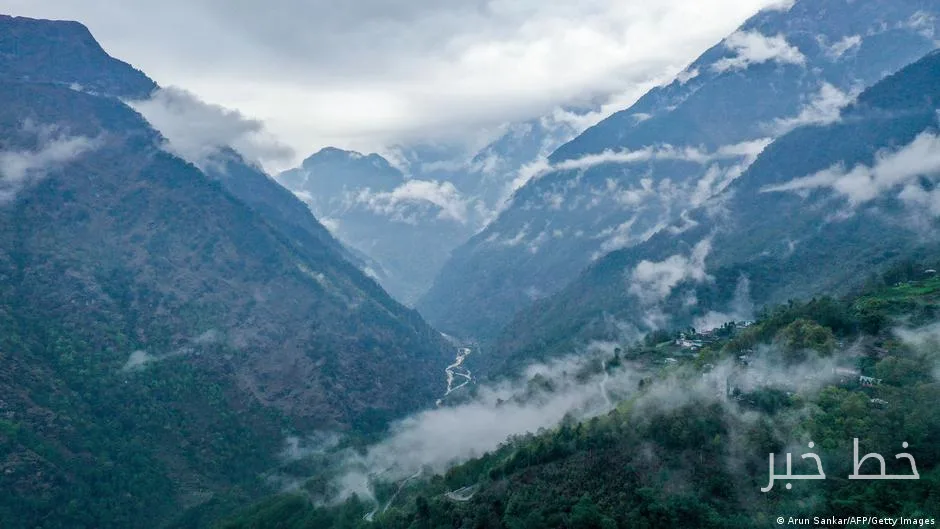
Border tensions between India and China in Arunachal Pradesh in northeastern India have sharply increased with warnings from Indian military officials. Shatrujit Kapoor, Director General of the Indo-Tibetan Border Police (ITBP), has reported confrontations between Indian and Chinese forces at several points along the de facto border.
Development of Tensions
Kapoor stated last month that in recent days, the situation has progressed to the point where Chinese forces have faced off against Indian forces at various locations in Arunachal Pradesh, and this situation continues. He also warned that confronting China through conventional means may be difficult, as the People's Liberation Army (PLA) and their border defense forces are heavily investing and modernizing.
Read more: Mother of one of the pilots of the crashed plane in Florida identified
The disputed border between India and China runs through a remote mountainous region, and in recent decades, clashes along the Line of Actual Control (LAC) have repeatedly created security crises between the two populous countries. Relations between Beijing and New Delhi remain affected by deadly violence that occurred in 2020, when both countries accused each other of attempting to seize territory.
Analysis of the Border Situation
In June 2020, a clash in the Galwan Valley in eastern Ladakh resulted in the deaths of 20 Indian soldiers and four Chinese soldiers. Kapoor's statements have drawn renewed attention to the Himalayan border. Pema Khandu, Chief Minister of Arunachal Pradesh, has also acknowledged border violations and stated that such incidents are not new and the situation at the border is normal.
Khandu pointed out the lack of proper border demarcation and added that China does not recognize the McMahon Line, which was drawn by the British Empire in 1914 and separates Arunachal Pradesh from Tibet. It is also unclear whether the recent confrontations between Chinese and Indian forces involved physical violence.
The opposition Congress party has strongly criticized Khandu's statements and accused the ruling party led by Narendra Modi of "justifying" China's actions instead of emphasizing India's position. Jairam Ramesh, General Secretary of Congress, stated that there has been silence from the Prime Minister and his institutions on this matter.
Meanwhile, Indian Ministry of External Affairs spokesperson, Randhir Jaiswal, has emphasized the change in the patrol routes of Chinese forces in border areas. Chinese Foreign Ministry spokesperson, Guo Jiaokun, dismissed these accusations, stating that Chinese forces are conducting "normal patrols" and are strictly adhering to bilateral agreements.
The Line of Actual Control primarily separates areas controlled by India and China, but given that forces from both countries recognize the areas as their territory, they sometimes enter disputed regions. Gautam Bambawale, former Indian Ambassador to China, stated that there is a simple reason for this: because there is no agreed-upon line between the two countries.
The de facto border is claimed by India to be 3,488 kilometers (2,167 miles) long, but China considers this measurement to be shorter. The two countries have held 25 rounds of talks between their special representatives since 2003, but have yet to reach an agreement on border demarcation.
This dispute is particularly sensitive in Arunachal Pradesh, where China considers it part of Southern Tibet. Arvind Yelri, a China expert at Jawaharlal Nehru University, states that this region has increasingly become strategic for Beijing.
Yelri added that both sides patrol the disputed LAC, and for this reason, tensions are inherently present in this agreement. He noted that what is new is China's increased focus on the eastern section of the border.
It seems that diplomatic actions taken by Indian and Chinese leaders will take time, and there is a significant gap between the promises of leaders and the actions that could prevent a recurrence of the events of 2020.
Read more: Trump spends election day in the White House · Widespread protests against voter list reforms in India