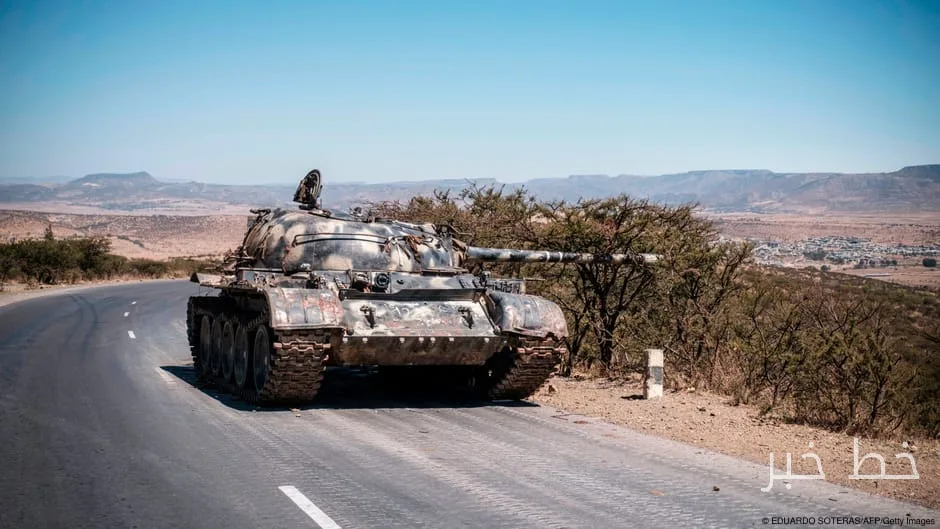
Recent clashes at the Ethiopia-Eritrea border, which had been in a state of relative stability for several weeks, have heightened fears of an all-out war. These clashes come as diplomatic relations between Ethiopia and Sudan have reached their lowest point.
Recent Developments at the Ethiopia-Eritrea Border
Forces allied with the Tigray People's Liberation Front (TPLF) launched an offensive on September 23 aimed at overthrowing the Ethiopian government as part of a larger coalition of rebels. However, the Ethiopian National Defense Forces (ENDF), aided by government-aligned militia, have gradually pushed the TPLF out of Tigray, a region in northern Ethiopia.
Read more: Germany's plan to establish a migration center in Rwanda faces criticism
According to a report by the ACLED monitoring organization, the ENDF has advanced towards Tigray, driving the Tigray Defense Forces (TDF) towards the Eritrean border. Clashes have been reported from several locations, and the ENDF has fired heavy artillery towards areas near the Eritrean border town of Badme.
The Historical Significance of Badme
Badme appears as a small rural town in satellite images, but it holds significant historical importance for both sides involved, as it was the main site of the Eritrean-Ethiopian War from 1998 to 2000, known as the Badme War.
This war ended with the Algiers Agreement, in which both countries agreed to respect the rulings of the Eritrea-Ethiopia Boundary Commission. This commission awarded Badme to Eritrea, a decision that Ethiopia has occasionally challenged. Abdulrahman Said, director of the Horn of Africa Regional Integration Center in London, states that Ethiopia may be attempting to regain Badme to help resolve its internal issues.
Domestic and Regional Impacts and Consequences
Said notes, "It seems that if Eritreans retreat and Ethiopians return, this could help calm the Tigrayans, especially those who currently support the ruling party in Ethiopia." He also pointed out that figures like Getachew Reda, former spokesperson for the TPLF and current advisor to Prime Minister Abiy Ahmed, may be able to attract the Tigrayan people towards the federal government with territorial gains for the Tigray region.
Analysts believe that Ethiopia's main goal right now may be to secure its northern border and disrupt supply lines between Eritrea and Tigrayan forces. However, securing control over Tigray could mean direct conflict with Eritrea.
Since Eritrea's independence from Ethiopia in 1993, Ethiopia has been the largest landlocked country in the world by population. Prime Minister Abiy Ahmed has repeatedly described the lack of access to the sea as an existential threat while emphasizing achieving maritime access through peaceful means.
Read more: Ukraine targets the Crimean bridge in an unprecedented operation · Russian ambassador to the US dies suddenly