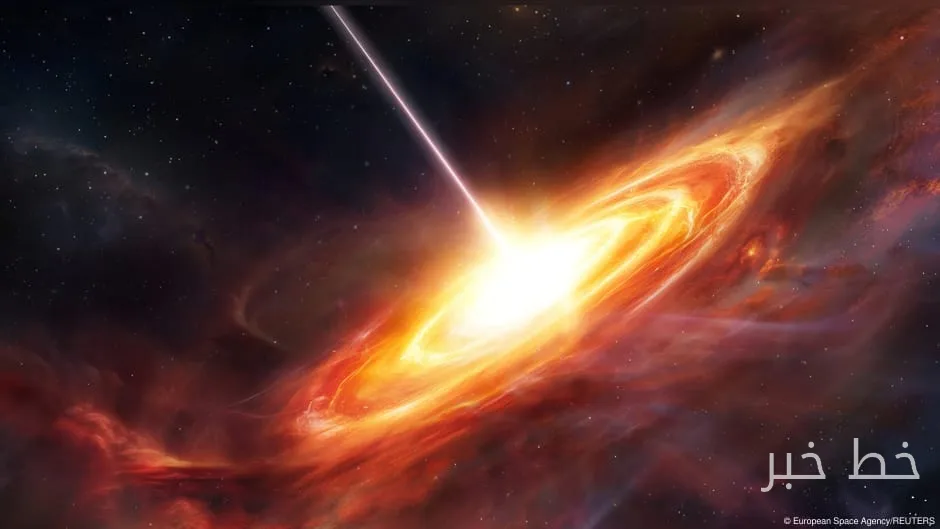
Scientists from the European Space Agency have reported the discovery of a distant galaxy that is the oldest and farthest known galaxy, having formed only 630 million years after the Big Bang. This discovery was made by a German astronomer and his team and published in the journal Astronomy and Astrophysics.
Characteristics of the Dún Aonghas Galaxy
Galaxies form very bright cores called quasars at different stages of their life, which are powered by gases falling toward a supermassive black hole. Quasars are recognized as a brief stage in the life of galaxies where the core can be significantly brighter than the entire system.
Sylvia Bladita, an astronomer and one of the authors of this research, explains: "When large amounts of gas, dust, and matter fall toward a black hole, a rotating accretion disk forms that heats up to extreme temperatures and radiates vast amounts of energy. This energy can make the entire galaxy hundreds or even thousands of times brighter."
Importance of the Dún Aonghas Discovery
The newly discovered galaxy, officially named J1504+6252, is known as Dún Aonghas. The red dot in the image corresponds to viewing the universe as it was about 13.1 billion years ago — only 5 percent of its current age.
Julion Wolf, an astronomer and the lead author of this research, stated: "This discovery adds evidence that some objects in the early universe developed significantly quickly. Only 630 million years after the Big Bang, this black hole grew to about 360 million times the mass of the Sun and became a bright quasar." This discovery supports a scenario in which supermassive black holes form through the direct collapse of large gas clouds and then accumulate additional matter.
Dún Aonghas was initially identified by the Euclid telescope of the European Space Agency, and its images have been described using a combination of ground-based and space telescopes. The ESA's orbiting telescope is designed for missions that help uncover the mysteries of dark matter and dark energy, known as the invisible glue that holds galaxies together and the force that drives them apart.