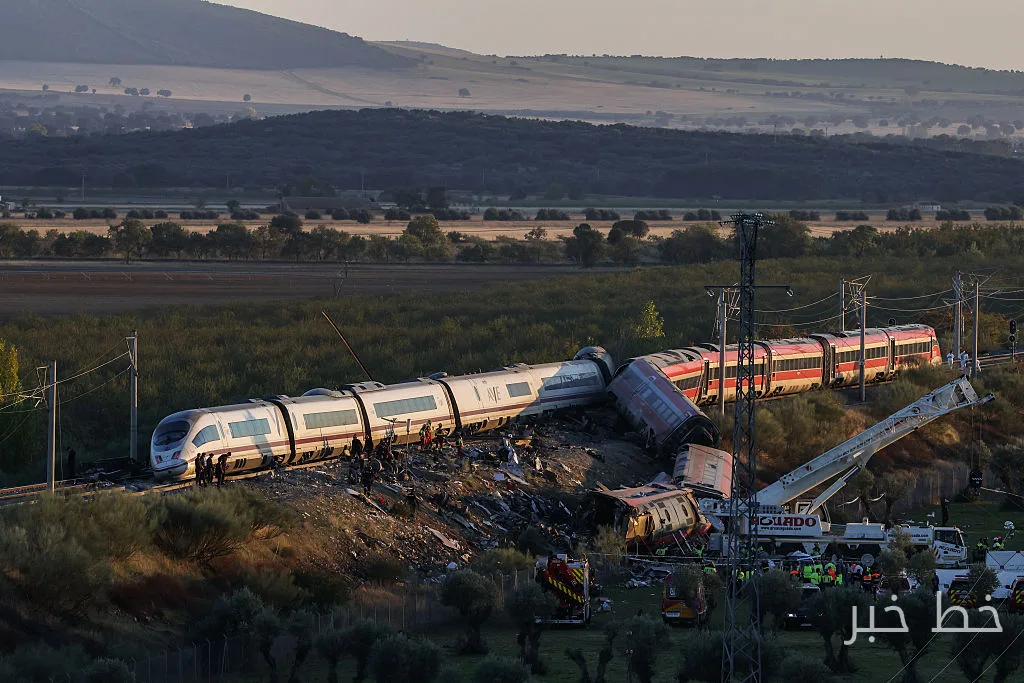
Spain's Transport Minister, Óscar Puente, announced that the high-speed train crash on Wednesday morning, which resulted in the deaths of at least 68 people and injured dozens more, occurred due to a combination of an "inexplicable" human error and a computer malfunction. The incident took place near Ocaña, in the province of Toledo, over 80 miles (130 kilometers) south of Madrid.
Details of the Crash and Investigations
Puente said at a press conference that the state-owned Renfe train collided with the rear of a private Irio train that had been standing still due to an "inexplicable" order from the Spanish train control center. He added that this center had faced a computer malfunction before issuing the order. He stated, "This control center, through its operators, decided to resume traffic under conditions that are inexplicable to us. It is clear that this was a wrong decision."
Read more: Israel Election Results: Netanyahu-led Coalition is Leading
The Transport Minister also noted that the individual who made the decision to continue the Renfe train's movement has been identified but has not yet spoken with the control center operator. He emphasized, "This individual will be subject to whatever the investigation determines."
Consequences and Reactions
The regional government of Castilla-La Mancha, where the city of Toledo is located, announced that 53 people are still being treated in medical facilities, and the number of individuals transferred to hospitals reached 107 earlier in the day. Renfe has announced that train services between Madrid, Ciudad Real, and Andalusia have been suspended.
This crash is now the deadliest train accident in the country since an incident in 2013 in Santiago de Compostela that left 80 people dead. The recent crash occurred after a similar accident in January, which resulted in 46 fatalities and 122 injuries.
Pedro Sánchez, the Prime Minister of Spain, who visited the crash site, announced that his government will declare three days of national mourning and is committed to an investigation into the matter. He said, "What is unacceptable for a country like Spain is to experience two high-speed train accidents in one year."
Puente noted at the press conference that Spain's rail system is "safe and comparable to other countries in the region." However, he acknowledged that "despite having very clear regulations and protocols, errors can certainly occur."
The crash involved a Renfe high-speed train heading towards Seville with 393 passengers on board. The Irio train was also carrying 151 passengers. The Renfe train departed at 8:00 AM local time, while the Irio train had set off a little earlier at 7:54 AM, and both were on similar routes.
Spain's rail infrastructure uses the German LZB (Linienzugbeeinflussung) system, which is a rail safety technology that monitors train speeds and sends traffic instructions to the driver's cabin. Operations must revert to manual control when the automatic safety system fails.
Puente announced at the press conference that around 8:30 AM, three computers in the railway network experienced communication failures, and the LZB control system went offline in a 63-kilometer section of the line. This automatically caused about six trains to stop in that section. The central command center had to manually manage rail traffic.
Read more: Preparations for Evacuating Residents of Olushki in Ukraine Have Begun · Train Crash in Spain Occurred Due to Incorrect Order to the Driver