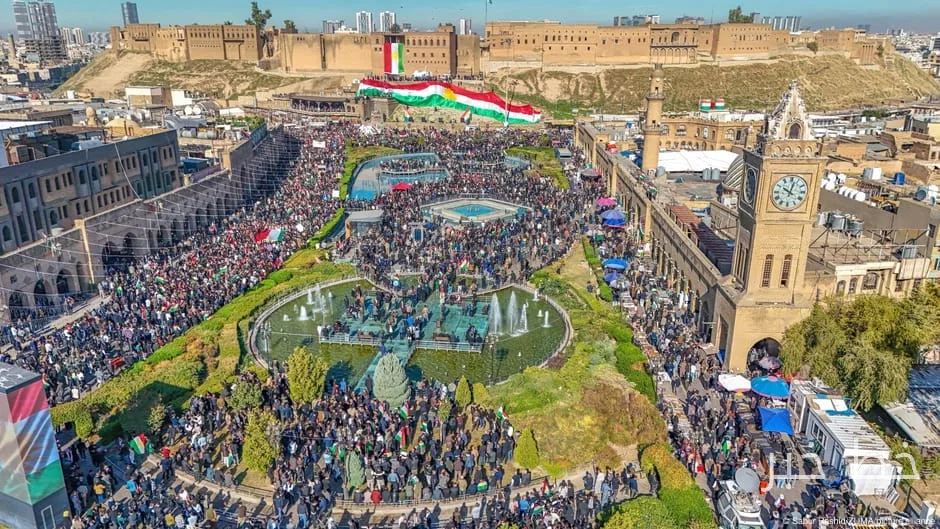
The people of Iraqi Kurdistan took to the streets on Thursday, holding large flags of their semi-autonomous region in Erbil, to stage widespread protests against the plans of the federal government of Baghdad. These protests were in reaction to recent decisions by the federal government to seize control of oil operations and borders previously managed by Kurdish officials.
Controversial Decisions by Baghdad
Ali Al-Zaydi, the Prime Minister of Iraq, announced that these measures were taken to prevent oil smuggling. These plans are seen as a sign of escalating tensions in the power struggle between the central government and Kurdish officials, who have been governing independently since 1991. Recent decisions, following approval from the Federal Supreme Court of Iraq, transfer border control in the Kurdistan region to the central government and place the authorization for oil exports from this region under the supervision of the federal Ministry of Oil.
Read more: Domestic violence statistics in Germany reached their highest level
Response from Kurdish Officials
The regional government delegation of Kurdistan announced on Wednesday that Baghdad's decision is considered "a violation of the constitution and the legal rights of the Kurdistan region" and deemed it an attempt to revert Iraq to a centralized regime. Additionally, the Prime Minister of Kurdistan, Masrour Barzani, expressed surprise at Al-Zaydi's decisions, describing them as "completely unacceptable."
The Federal Supreme Court of Iraq ruled on Wednesday that the regional laws of Kurdistan only apply to the territories under its administration as of March 19, 2003. After the coalition forces led by the United States overthrew Saddam Hussein, Kurdish Peshmerga forces entered many disputed areas and took control of oil fields.
The oil-rich Kurdistan region is critically important to both governments in a country that relies on oil revenues to fund its public budget. Internal political tensions in Iraqi Kurdistan have complicated the situation in recent months, as the Federal Supreme Court is currently addressing legal challenges against the legitimacy of the current government.
However, it seems that rival Kurdish parties have reached an agreement on this issue and have united against Baghdad's decisions. Protests have also been reported in other cities and towns, reflecting public dissatisfaction with the central government's policies.
Read more: Increase in the repression of lawyers in Iran · Gas prices reached a new record on election day