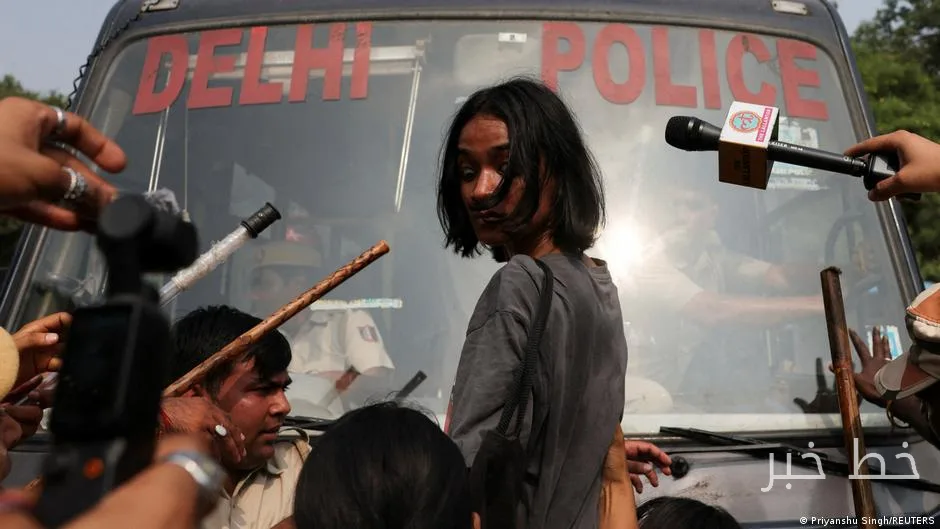
Nishapur, an activist and Indian student, went to the judge's office in New Delhi with their partner on July 20 to get married. As they arrived at the location, they faced a tense situation; police were gathering to stop a youth protest that was heading towards Parliament. The judge's office staff and the couple's marriage witnesses were also delayed due to the barriers.
Protest Movement and Demands
The protest movement known as the Youth Party of Cockroaches (CJP) announced this march to demand the resignation of the then Minister of Education of India, Dharmendra Pradhan. Protesters faced severe resistance from security forces, which included batons, tear gas, and rubber bullets. These confrontations led to injuries and widespread arrests.
The Youth Party of Cockroaches began as a satirical online movement after the Chief Justice of India, Surya Kant, referred to unemployed youth as "cockroaches" in an informal comment. The name of this party indirectly references the ruling Bharatiya Janata Party (BJP).
After successfully ousting Pradhan in late July, CJP is now calling for the resignation of Chief Election Commissioner Gyanesh Kumar, who has faced criticism for removing over 130 million names from national electoral rolls.
Role of Women and Student Activists
While CJP leaders are in judicial custody or at risk of arrest, the name of one student leader, Neha Bora, has quickly become a symbol of this protest. Bora, who uses they/them pronouns, is at the forefront of the protests, escaping from the streets from police, crossing barriers, and shouting slogans from detention vans.
Bora is the president of the All India Students Association (AISA), the student wing of the Communist Party of India (Marxist-Leninist) Liberation. They say, "In desperate times, people try to gather hope from every source... If these individuals are fighting, then we can fight too."
The protests led by CJP coincide with calls from women and members of the LGBTQ+ community for increased autonomy for women following the gang rape of a 17-year-old girl in New Delhi. This incident has once again brought the issue of safety in India to the forefront.
According to the National Crime Records Bureau (NCRB), in 2024, 441,534 cases of crimes against women were recorded, averaging 1,210 cases per day. Experts say that these official statistics only reflect a partial account of gender-based violence.
Women and non-binary individuals leading this movement defy their victimhood despite sexual harassment from police and online attacks. Kavita Krishnan, one of the activists, states, "The issue of 'Beti Bachao' [Save the Daughter] no longer resonates with this generation. Our demand is very specific: see us as political and free beings."
Meanwhile, Gurmher Kaur, a writer and activist, explains how her male colleagues are happy to be in the media, but for her, "attention equates to threats of death and rape and humiliation." In this context, Naat has a similar experience and says, "If a woman leads a protest, the first attack is on her gender."
Delhi officials deny allegations of mistreatment of female protesters, claiming they were treated with "respect." However, Bora refutes this claim, stating that there were very few female personnel available to manage a large number of female protesters.
Despite pressures and threats, protesting women take to the streets and continue their demonstrations. Krishnan says, "They don’t know what they are dealing with." She emphasizes that this generation does not see sexual violence as something shameful.
Read more: Use of force in Mississippi shooting that killed one-year-old justified · Saudi Arabia executes two Bangladeshi citizens