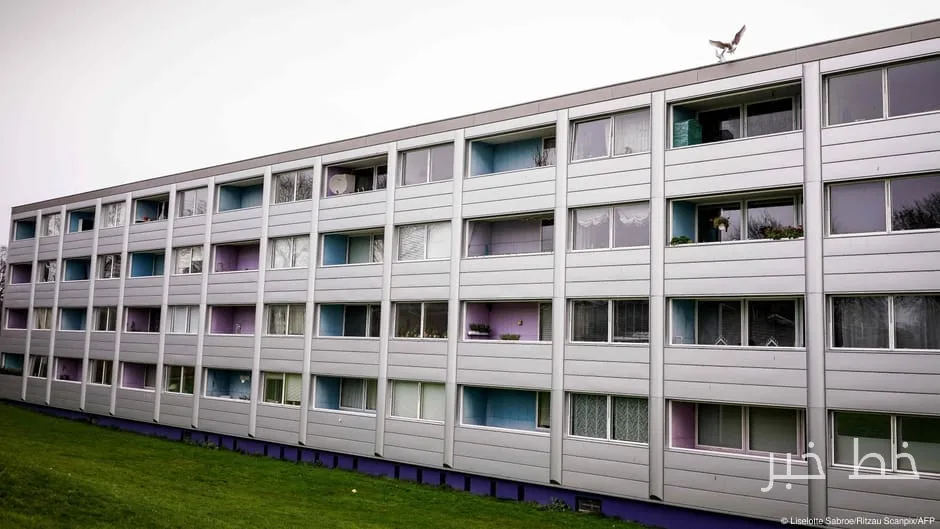
The Supreme Court of Denmark ruled on Monday in favor of a housing association that canceled 91 leases to prevent the 'hard ghetto' label on its residential complex. This ruling aligns with Copenhagen's strict approach to immigration.
Confirmation of the 'Ghetto' Law
On Monday, the Supreme Court confirmed Denmark's 'Ghetto' law, which was enacted in 2018. This law allows the government to relocate 'non-Western' residents from neighborhoods with heavy minorities to facilitate integration. This ruling by the Supreme Court of Denmark differs from a decision by a European Union Supreme Court last year, which stated that the implementation of this law could lead to discrimination.
Read more: John Kennedy considered Trump's meeting with Putin and Xi a positive move
New Housing Regulations
The Danish law requires social housing neighborhoods to undergo reconstruction, renovation, and changes in their social composition if they become heavy minorities. According to this law, by 2030, 60% of apartments must be rented to 'Westerners' at market prices.
Denmark has become a model for some countries in the European Union with its strict immigration laws. The country was also one of five that announced last week its intention to establish a refugee deportation center in Rwanda.
Response from the Danish Minister of Housing
The Danish Minister of Housing, Jakob Mark, welcomed Monday's ruling, stating that this decision 'strengthens security, social solidarity, and integration.'
The Supreme Court's ruling upheld a lower court's decision in 2022 against seven tenants who were fighting their evictions in the Nørrebro area of Helsingør, located north of Copenhagen.
Social and Economic Consequences
In Monday's ruling, the law was recognized as non-discriminatory regarding the eviction of 'migrants and their descendants from non-Western countries,' as this law is not generally based on race. The European Union Supreme Court noted this specific aspect and stated that the law would be discriminatory if the criteria were based on race, while ultimately allowing national courts to make the final decision in this matter.
Tenant associations estimate that around 11,000 people across Denmark will need to be relocated to comply with this law. The relevant housing association stated in a written statement that it is aware of the impacts of these evictions on those affected and has taken necessary actions to ensure that residents find new homes.
Definition of Non-Western Countries
According to Denmark's statistical definition, 'non-Western' countries include all countries except the 27 member states of the European Union, as well as Andorra, Australia, the United Kingdom, Canada, Iceland, Liechtenstein, Monaco, New Zealand, Northern Ireland, Norway, San Marino, Switzerland, the United States, and Vatican City.
Read more: Trump likely to favor attacks against Iran after the New Year · Execution of two men in Saudi Arabia for terrorism charges