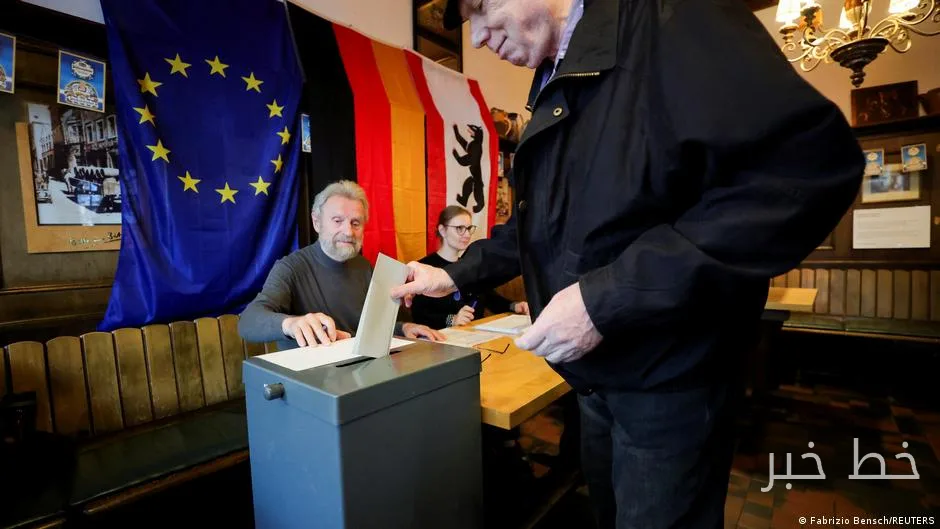
Voting in two important state elections in Germany, Berlin and Mecklenburg-Vorpommern, has begun. Voters in these areas are standing in long lines to cast their votes, and candidates are also present at polling stations to vote for themselves.
Candidates' Presence in the Elections
In the German capital, Werner Graf (Green Party) and Stefan Krach (Social Democrats) cast their votes in the Tempelhof-Schöneberg constituency. In the north, Leif-Erik Holm (far-right AfD party) also cast his vote in Schwerin, the capital of Mecklenburg-Vorpommern.
Read more: Cuba faces its seventh complete power outage this year
Holm told local media that he is optimistic about his party's chances, stating: "The clouds have cleared and the sky has turned blue," referring to his party's color.
Election Challenges and Social Issues
In the Berlin elections, one-quarter of the city's residents do not have the right to vote due to lack of citizenship. This is the highest proportion of people excluded from this election, and many of them are dissatisfied.
The left-wing party, Die Linke, is leading in the polls and is in close competition with the conservative CDU party. In the state of Mecklenburg-Vorpommern, the main competition is between the Social Democrats (SPD) led by Manuela Schwesig and the AfD, with both parties closely competing in the polls.
Schwesig recently stated: "The situation is serious, the AfD will harm our economy and threaten our social cohesion. Their harsh words and hate-mongering are tearing our society apart. This issue will particularly affect women."
The elections in Berlin and Mecklenburg-Vorpommern are taking place following the recent successes of the AfD in the state of Saxony-Anhalt, where the party garnered nearly 44 percent of the votes. Currently, 17 parties are participating in the Berlin elections, including Die Linke, CDU, and AfD.
Economic issues and housing shortages in Berlin are major concerns for voters. Rent costs in the city have doubled, and by 2040, there is a need for 211,000 new homes. Only the left party has so far made a promise to act on the 2021 vote in which 59 percent of Berliners called for government control over apartments from the largest landlords.
Read more: Greg Stanton joins the electoral race in New Hampshire · The far-right party in Germany became the strongest party in the Saxony-Anhalt elections