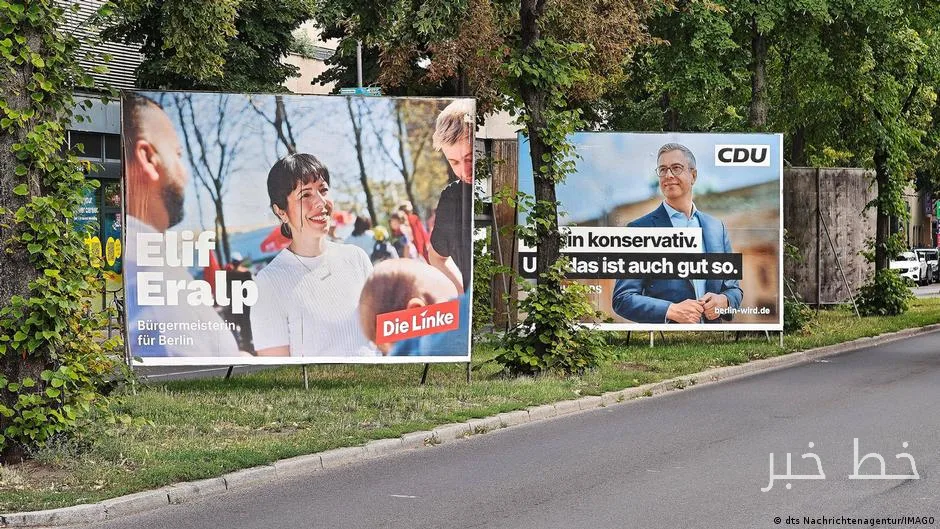
The Berlin state elections will be held on September 20, 2023, with the three main parties, namely the Left Party, the Christian Democratic Union (CDU), and the right-wing Alternative for Germany (AfD), in close competition. This election is set to choose the state parliament, which will ultimately determine the next mayor of Berlin.
Political Analysis of Berlin
Berlin, with a population of over 3.9 million, is known for its cultural diversity, but it is also highly diverse and fragmented. Central areas of Berlin typically vote for the Green Party or the Left Party, while the suburbs are predominantly dominated by the CDU and, in some areas, the AfD. This situation has made predicting the Berlin elections particularly challenging, especially in recent years as more parties enter the fray during elections.
In a recent poll, the Left Party leads with 21 percent, followed by CDU with 20 percent and AfD with 18 percent. The Greens also follow with 16 percent, and the Social Democratic Party (SPD) with 12 percent. The relative weakness of the AfD in Berlin indicates that the situation is not as acute as in Saxony-Anhalt on September 6, where the victory of the right-wing extremists is likely to lead to their entry into government.
CDU's Challenges in the Election
A victory for the Left Party, especially another defeat for the CDU, could transform Berlin's politics. The CDU is currently in government and faces many political challenges. Lukas Krieger, the Secretary General of the CDU in Berlin, stated, "Berlin is particularly challenging." As a member of the federal parliament, he is well aware of the consequences of regional elections.
However, he believes that Berlin cannot be compared to the whole country or Saxony-Anhalt. Krieger also added that the main competition is now between the CDU and the Left Party, and the AfD has no option for negotiation. Meanwhile, the CDU is also grappling with the loss of the previous mayor, Kai Wegner, who will not run in the elections due to his decision to play tennis during the largest blackout in Berlin since World War II.
Election Competitions and Candidates
Stefan Ores, Wegner's finance minister, has been introduced as the new CDU candidate and now must navigate between two different political threats, namely the AfD and the Left Party. He will compete against another rival named Elif Eralp, a Munich-born lawyer born in 1980. Polls indicate that none of the mayoral candidates are particularly well-known, and about half of Berliners do not have strong feelings towards them.
While the CDU faces serious challenges, observations indicate that German politics is becoming increasingly radical, a situation partly related to the failure of centrist parties to provide new solutions to voters. According to Julia Reichenbach, a political scientist, the Left Party is recognized as the most credible opponent of the AfD in Berlin, as it is unwilling to support the CDU.
However, the Left Party also faces challenges and has been accused of anti-Semitism. This comes as the Left Party seeks to clearly articulate its demands, especially regarding social and economic issues. This approach seems to attract more attention and support from voters.