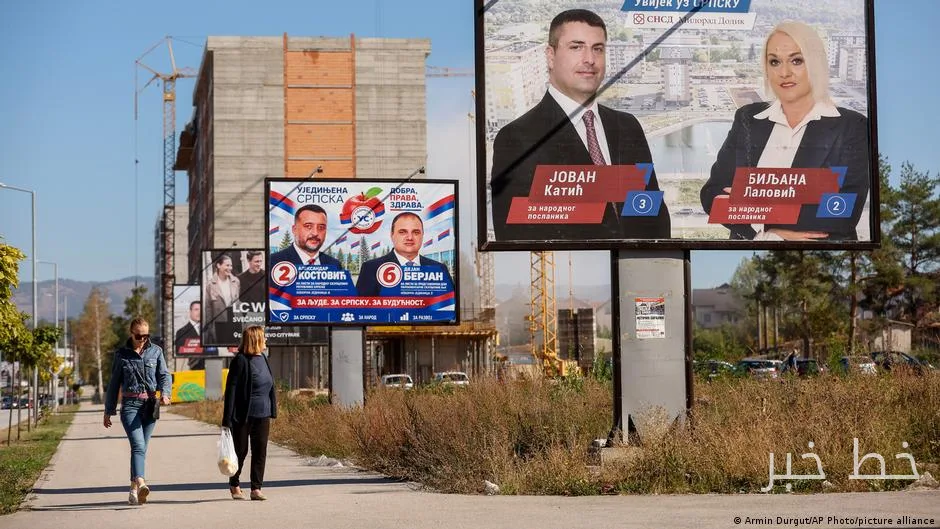
The general elections in Bosnia and Herzegovina concluded on Sunday with the closing of polling stations. Approximately 3.4 million voters participated in these elections, which included the election of officials at various levels of government, including members of the multi-ethnic presidency.
Preliminary Election Results
As the counting of votes began, various candidates including Željka Cvijanović from the Serbian nationalist party, Denis Bećirović from the Bosniak moderate party, and Darijana Filipović from the Croatian nationalist party are in the lead. Cvijanović has the support of Milorad Dodik, the former leader of the separatist Republic of Srpska, who has been barred from holding public office for six years.
Challenges Facing Bosnia and Herzegovina
The elections were held amid multiple challenges facing Bosnia and Herzegovina, including economic stagnation, slow progress towards EU membership, and a political deadlock. Dominant ethnic parties have repeatedly delayed central government decisions that connect them through two different entities.
The elections also witnessed competition among rival ethnic parties such as the Party of Democratic Action (SDA), the Serbian Nationalist Party (SNSD), and the Croatian Nationalist Party (HDZ BiH) and multi-ethnic opposition coalitions led by the Social Democratic Party.
Polling stations closed at 7 PM local time, and preliminary results will soon be announced that evening. Economic, administrative, and political responsibilities in Bosnia and Herzegovina are divided among the multi-ethnic central government, two semi-autonomous entities, and the neutral region of Brčko.
This complex framework, which is divided along ethnic lines, was established in the 1995 Dayton Peace Agreement following the Bosnian War. The population of Bosnia and Herzegovina is approximately half Bosniak Muslims, 31 percent Orthodox Serbs, and 15 percent Catholic Croats.
In recent years, Bosnia and Herzegovina has been calm, but ethnic nationalist parties continue to perpetuate divisions while voters seek to move beyond the approaches and divisions of the war era.
In the Republic of Srpska, Milorad Dodik, the separatist leader of the SNSD party, has remained a key figure despite not participating in the elections. Dodik, who has a history of presidency in this entity, recently returned from Moscow and called for close ties with Serbia and Russia.
In the Muslim-Croat Federation, Bosniak parties are seeking to strengthen the central government. The main Bosniak party (SDA) focuses on efforts to maintain the unity of the country against Serbian separatism.
Meanwhile, Denis Bećirović, the current member of the Bosniak presidency, has promised to create a new path towards the EU and NATO. Bosnia and Herzegovina has been recognized as a candidate for EU membership since 2022.
However, the actual start of membership negotiations depends on the implementation of several reforms, including strengthening judicial oversight and passing anti-corruption laws.
Read more: Maya Sandu condemned Russian airstrikes on Moldova