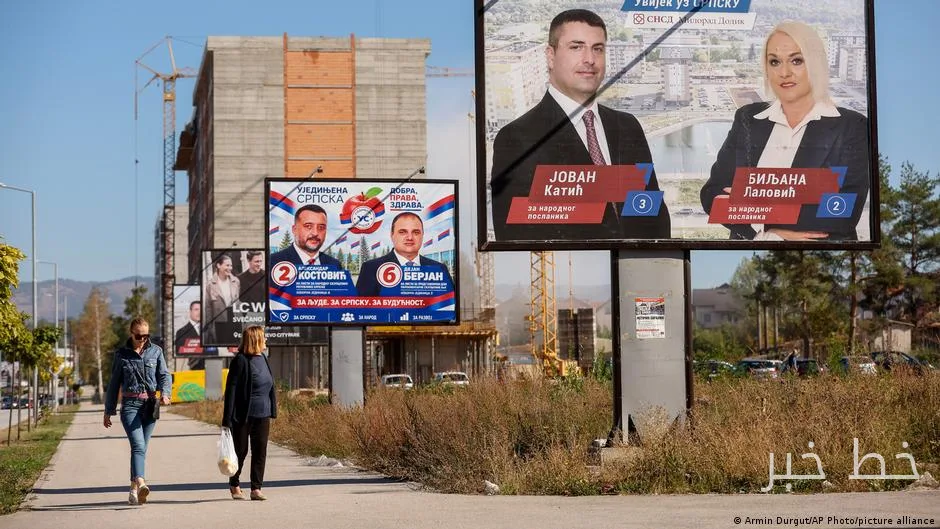
The general elections in Bosnia and Herzegovina began on Sunday, with about 3.4 million eligible voters in this Balkan country heading to the polls. Citizens will elect officials at several levels of government, including members of the multi-ethnic presidency and representatives of the federal parliament.
Challenges Facing Bosnia and Herzegovina
The elections are taking place under circumstances where Bosnia and Herzegovina is facing multiple challenges. Economic stagnation, slow progress on the path to European Union membership, and a prolonged political deadlock are among the main issues facing the country. Dominant ethnic parties have repeatedly delayed central government decisions that connect the two autonomous entities.
Read more: Pete Hegseth Moves Some U.S. Forces to the Western Hemisphere
Election Competitions and Parties
In this election, rival ethnic parties including the Party of Democratic Action (SDA), the Serbian Nationalist Party (SNSD), and the Croatian Democratic Union of Bosnia and Herzegovina (HDZ BiH) are facing off against multi-ethnic coalitions led by the Social Democratic Party. Voting continues until 7:00 PM local time, and initial results are expected to be released late Sunday.
Economic, administrative, and political responsibilities in Bosnia and Herzegovina are divided between the multi-ethnic central government, the autonomous region of Brčko, and two semi-autonomous entities. These entities are further divided into several cantons and communities.
A complex framework shaped along ethnic lines was established in the Dayton Peace Agreement signed in 1995. Currently, about half of the population of Bosnia and Herzegovina are Bosniak Muslims, 31% are Orthodox Serbs, and 15% are Catholic Croats.
Bosnia and Herzegovina has enjoyed peace in recent years, but ethnic parties continue to maintain divisions while voters tend to want to move beyond the discourse and divisions of the war era. In the Republika Srpska, Milorad Dodik, the separatist leader of the SNSD, remains a key figure.
Dodik, the former head of this Serb-dominated entity, is barred from holding public office for six years due to violations of laws under the supervision of an international envoy. Sado Minić, a Dodik supporter, is running as a presidential candidate for the Republika Srpska.
In the Muslim-Croat Federation, Bosniak parties are calling for strengthening the central government. The main party, SDA, focuses on efforts to maintain the unity of the country against Serb separatism. Additionally, Denis Bećirović, the current Bosniak member of the presidency, has promised to pursue a new path toward the European Union and NATO. Bosnia and Herzegovina has been a candidate for EU membership since 2022, but the actual start of membership negotiations depends on the implementation of numerous reforms.
Read more: Samuel Alito: Voting to Overturn Roe v. Wade Required Courage · Current Situation in Bosnia and Herzegovina Affected by War and Separatism