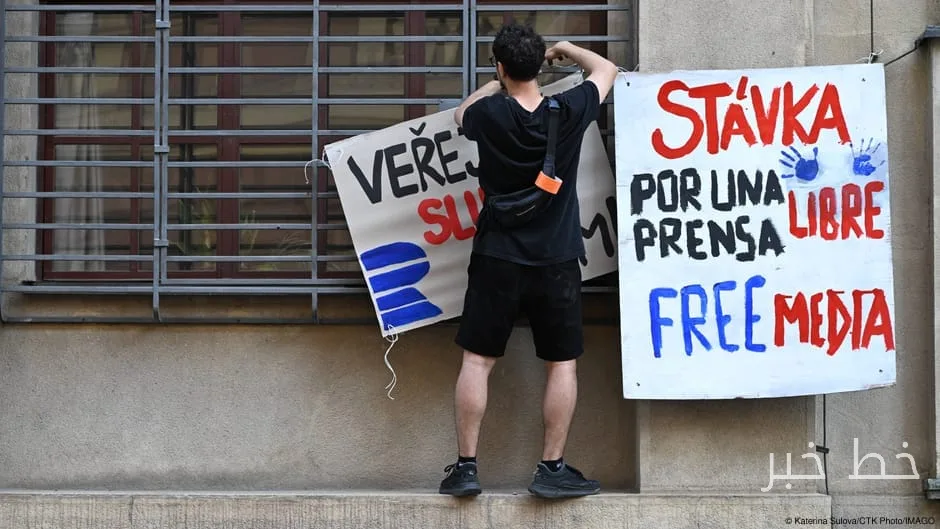
Hundreds of thousands will gather in Prague on Sunday to protest the Czech government's proposed reforms regarding the funding of public media. These reforms were initiated following the government's attempt to pass a law in parliament, which was suddenly introduced in a late-night session at the end of last month.
Details of the Proposed Reforms
The coalition government led by Andrej Babiš, the Prime Minister of the Czech Republic, completed the first stage of three stages of approval for this law with a positive vote at 4:36 AM on October 24. According to this proposal, the license fee model that currently funds Czech Television (CT) and Czech Radio (CRo) will be abolished, and these media will be directly funded from the state budget.
Read more: Absolute Victory of America Over Iran at High Costs
Reactions and Public Protests
This plan has already sparked numerous protests and strikes across the country, but the gathering on Sunday in Letná Park in Prague is likely to be the largest protest to date. Coalition parties, including ANO led by Babiš, the far-right SPD, and motorcyclists, believe that the license fee is an unfair tax burden and that these changes will enhance media efficiency.
However, critics have strongly rejected these justifications and accused the government of attempting to undermine media independence. They argue that these changes will lead to cuts in personnel and programming and provide no guarantees for financial stability and editorial independence.
Civil groups, including “A Million Moments for Democracy,” which is organizing the Sunday gathering, have previously held large protests against the Babiš government in 2019 and earlier this year. This group has emphasized the need to continue pressuring the government and stated that “words have no value” and the government must respond to the people's demands instead of actions that seem to seize the country.
It appears that despite no signs of a decrease in protests, the government is facing a serious challenge. While polls indicate that political support for the government has declined, experts warn that the media issue may become a focal point of broader discontent.