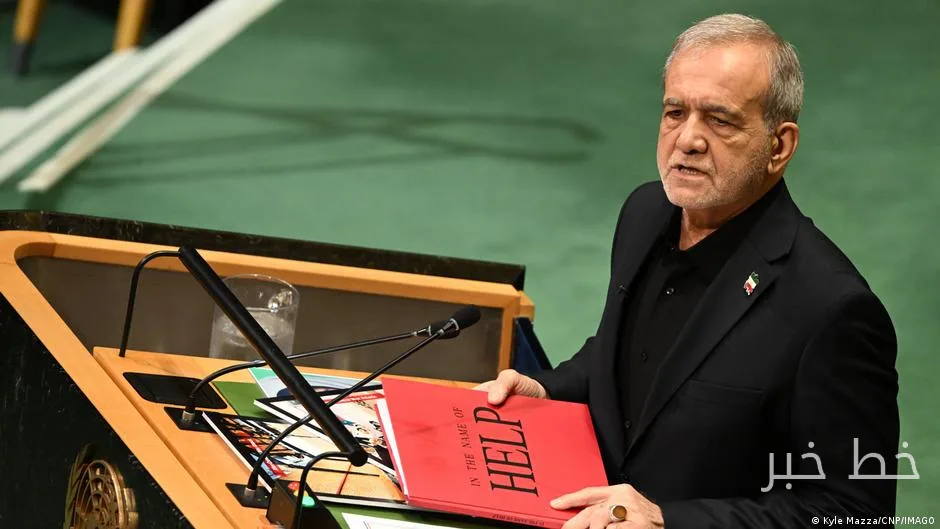
Iran's President, Masoud Pezeshkian, met with journalists and representatives of American media during his trip to New York to attend the UN General Assembly. In this meeting, he expressed his willingness to make concessions in the nuclear dispute with the United States.
Pezeshkian's Response to Nuclear Questions
In an interview with Fox News, Pezeshkian explicitly stated that Iran will adhere to its commitments under international law and the Non-Proliferation Treaty. In response to the question of whether Iran is ready to surrender its enriched uranium, he stated: "We will fulfill our commitments."
Read more: The judge issued an order to restore the credentials of CNN, MS NOW, and Politico journalists
According to the latest assessments, the International Atomic Energy Agency (IAEA) estimates that Iran has over 440 kilograms of uranium enriched to 60 percent. However, Pezeshkian responded negatively to a direct question about Iran's desire to have a nuclear bomb, stating that Iran's Supreme Leader has repeatedly declared that this action is religiously undesirable and illegal.
Outlook on Negotiations and Tensions
Despite Pezeshkian's statements, the International Atomic Energy Agency believes that Iran's fissile materials are far greater than needed for civilian enrichment. Analysts believe that significant changes in Iran-U.S. relations are not expected in the near future.
Arman Mahmoudian, an expert on Iranian issues at the University of South Florida, pointed out that Pezeshkian lacks sufficient authority to initiate comprehensive de-escalation with the United States, and particularly, hardliners and the Islamic Revolutionary Guard Corps continue to influence Iran's decision-making process. However, he believes that Pezeshkian's trip could help establish a more direct communication channel between Tehran and Washington.
Mahmoudian also mentioned the possibility of creating a framework for future negotiations in New York, adding that both sides may propose a roadmap for more meaningful talks and, in the long term, de-escalation. He noted that there are signs of these discussions, including recent meetings between Iranian and American delegations.
Meanwhile, Iran's Foreign Minister, Abbas Araqchi, has referred to reports that Tehran has made a proposal to Washington to resume negotiations. According to this proposal, the Strait of Hormuz could be reopened within seven days if specific conditions are met.
The Strait of Hormuz, through which about 20 million barrels of oil pass daily, has become one of Iran's significant sources of power. The United States has been unable to eliminate all of Iran's capabilities to threaten maritime transport in this strait, which has become a new challenge for Washington.
Read more: Victory of right-wing extremists in the Saxony-Anhalt state elections in Germany · Tim Kaine calls for an immediate end to the Iran war