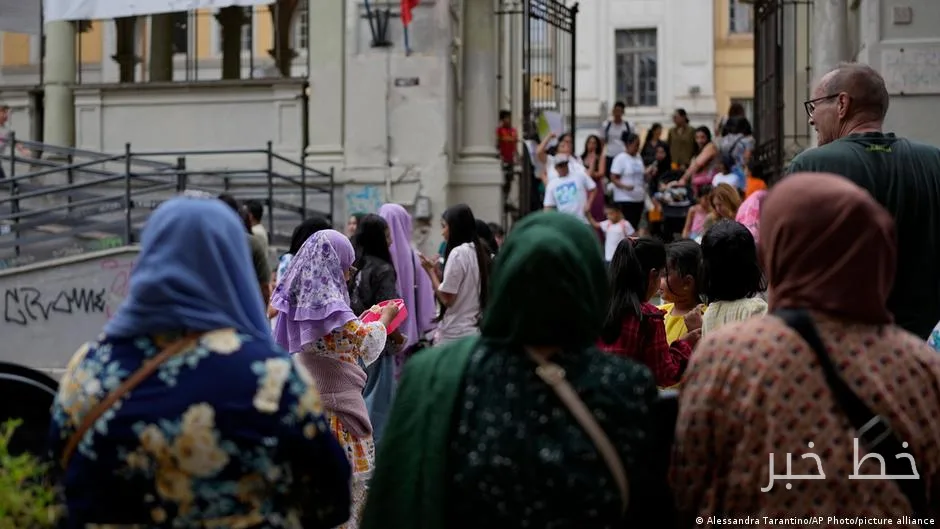
The conservative government of Italy approved a new law on Thursday that bans Islamic face coverings, including the burqa and niqab, in schools. This law also addresses the limitation on the number of students with weak Italian language proficiency in each class.
New Steps for Integration
Giorgia Meloni, the Prime Minister of Italy, described these measures as "common sense tools that do not cause division" and stated that these laws will aid integration and prevent the creation of "ghetto classes." She added that these laws provide equal opportunities for all students.
Read more: Ahmed Al-Sha'ra sidelined at the UN General Assembly
Reactions to the New Law
Opposition parties and other critics have strongly protested Meloni's government's action. Some have called it a "witch hunt" and accused the government of turning immigration into a political issue. These measures will take effect immediately but require parliamentary approval within 60 days. Meloni's coalition currently holds a majority in the legislature.
This law bans the burqa and niqab in schools, but the hijab remains permitted. Meloni stated in a television interview that the ban on the burqa is a "security issue" and added: "When a woman or worse, a young girl, is forced to cover her face, her fundamental rights and the integrity that is usually addressed are overlooked."
Impacts on Educational Environments
Giuseppe Valditara, Italy's Minister of Education, stated that this law will affect about 1,000 classrooms, which is equivalent to 0.3 percent of all schools in the country. According to official data, non-Italian citizens made up 11.2 percent of Italy's student population in the years 2022 to 2023.
Opponents of this law are concerned that the new measures may force students to attend schools far from their neighborhoods. There are also concerns about how these laws will be implemented in areas with large immigrant populations.
The independent child rights organization "Save the Children" called on Wednesday for a review of this action with "maximum political responsibility," adding that this action may lead to discriminatory effects. The organization stated in a statement: "Such a measure creates 'first-class' and 'second-class' students."
Meanwhile, Elly Schlein, the opposition leader, has strongly protested this law, criticizing Meloni's government for "a new witch hunt at the expense of children." Meloni heads the most right-wing government in Italy since World War II.
Read more: University Sports Bill Faces Serious Challenges in the House of Representatives