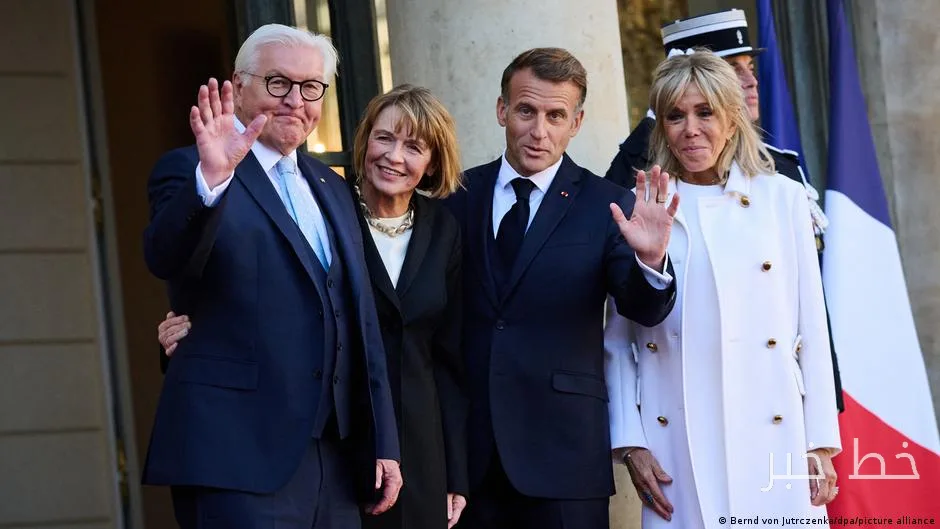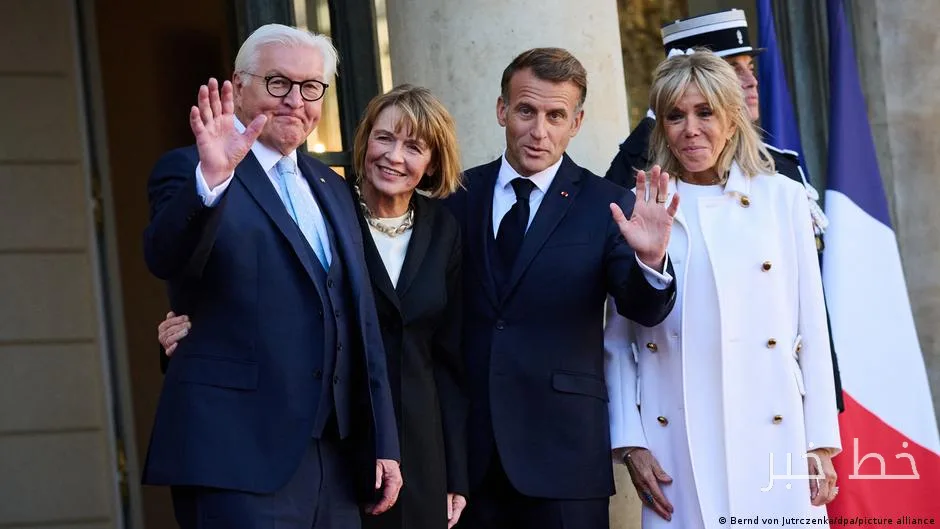
During their recent visit to Paris, Macron and Steinmeier sought to strengthen the France-Germany relationship, which has been affected by political and economic challenges. During this trip, the German delegation passed through the student protests in the streets of Paris without any hindrance, but traffic around the Arc de Triomphe and the Champs-Élysées was halted for several hours.
Macron's Symbolic Gesture
Emmanuel Macron decided to make a symbolic gesture by holding a military tribute ceremony for Steinmeier under the Arc de Triomphe. The German national anthem resonated early in the heart of Paris, while the cold and sunny weather made the event even more special. Despite its friendship and symbolism, this action seems to reflect a bygone era.
In both countries, support for populists is on the rise. In Germany, the right-wing Alternative for Germany (AfD) is leading in polls, and in France, Macron may soon face Jean-Luc Mélenchon from the far-left or Marine Le Pen from the far-right.
Economic and Social Challenges
Moreover, the economic crisis poses a threat to the welfare of both countries. Unresolved issues of social justice are driving youth to the streets. Macron also pointed to the increase of misinformation on social media and its impact on democracy.
Jacob Ross, a political scientist, noted that Macron and Steinmeier lack a "real plan" for Germany, France, and Europe. He stated that both represent political systems trying to respond to 21st-century crises with 20th-century solutions.
Despite political differences, Ross sees similarities in the approaches of Steinmeier and Macron, especially in foreign policy. He referred to the two countries' policies towards Russia, stating that they previously tried to bring Russia closer to Europe but were forced to change course after the events of 2022.
German Defense Minister Boris Pistorius announced during his visit to Paris that Germany has decided to withdraw from the tank project. However, he later clarified that his statements were ambiguous, and some observers see these misunderstandings as a sign of dissatisfaction from both sides regarding existing cooperation.
Pistorius firmly denied the claim of halting the MGCS project and emphasized that this project is still ongoing and a key initiative for cooperation between France and Germany in ground systems.
On Friday, the Presidents of France and Germany visited several centers near Bordeaux related to space exploration and nuclear deterrence. This included ArianeGroup, a Franco-German company that produces M51 nuclear missiles for France's nuclear submarines. The trip also included visits to startups looking towards a more distant future.
Unofficial reports suggest that this focus on space exploration has been a personal priority for Macron. He has long discussed the European dimension of France's nuclear deterrence. Given the United States' announcement of reducing its commitments to Europe, his comments are gaining increased attention.
Steinmeier's two-day visit to France concluded on Friday, and so far, there are no significant signs of renewed momentum in France-Germany relations. This situation necessarily increases the urgency for the successors of the two Presidents to develop a shared vision for the future of relations between the two countries next year.