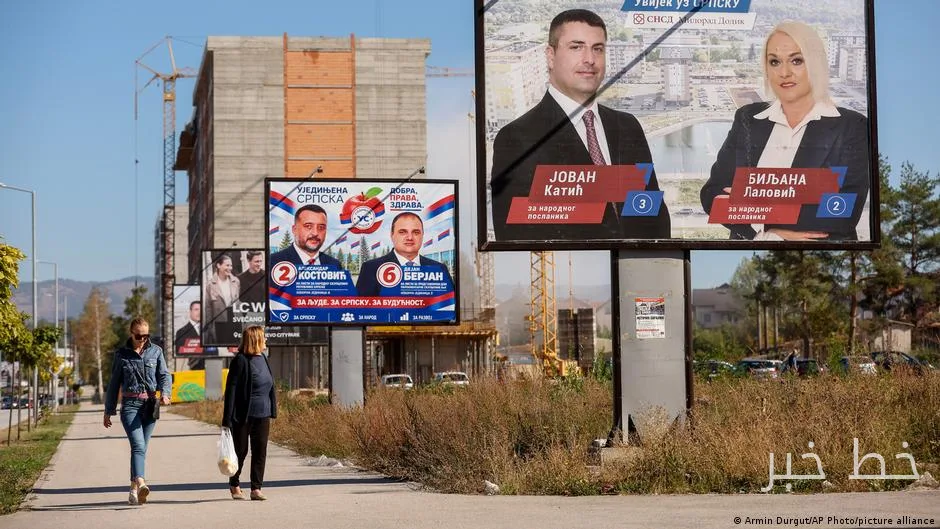
In the general elections held on Sunday in Bosnia and Herzegovina, nationalists achieved victory, with voter turnout dropping to its lowest at 41.5 percent of 3.4 million voters.
Election Results and Nationalist Victory
In this election, nationalist parties won in contests that included members of the country’s multi-ethnic and tripartite presidency. As the counting of votes neared completion, Željka Cvijanović from the Serbian nationalists, Denis Bećirović from the moderate left, and Daria Filipović from the Croatian nationalists were announced as the winners of the presidential seats.
Read more: Controversial Elections in Bosnia and Herzegovina Concluded
Cvijanović secured 55.6 percent of the votes with the support of Milorad Dodik, the former leader of the separatist Republic of Srpska, who has been barred from public duties for six years. Dodik, who faced this ban for defying the international high representative overseeing the 1995 peace process, told his supporters in Banja Luka: "We have won."
Challenges Facing Bosnia and Herzegovina
Bosnia and Herzegovina faces economic challenges, slow progress towards EU membership, and a political deadlock. The dominant ethnic parties in the country have repeatedly stalled decision-making in the central government that binds them together. This election took place at a time when the Bosniak SDA, Serbian SNSD, and Croatian HDZ BiH were competing against multi-ethnic opposition coalitions led by the Social Democratic Party.
After the polls closed at 19:00 local time, preliminary results will be published soon, but due to the complex legal framework and lengthy coalition negotiations, the actual results of this election may take months to finalize.
Economic, administrative, and political responsibilities in Bosnia and Herzegovina are divided among the multi-ethnic central government, two autonomous entities FBiH and RS, and the self-governing Brčko District. These entities are further divided into several cantons and communities, and this complex framework was established along ethnic lines following the Dayton peace agreement in 1995.
While Dodik remains a key figure in the elections, Denis Bećirović, the current member of the presidency of Bosnia, has promised to initiate a new path towards the EU and NATO. Bosnia and Herzegovina has been recognized as a candidate for EU membership since 2022, but the actual start of membership negotiations depends on the implementation of several fundamental reforms.
Read more: Russia Attacks Key Bridge in Kyiv · Kansas Democratic Senate Candidate Says No to Working with Harris