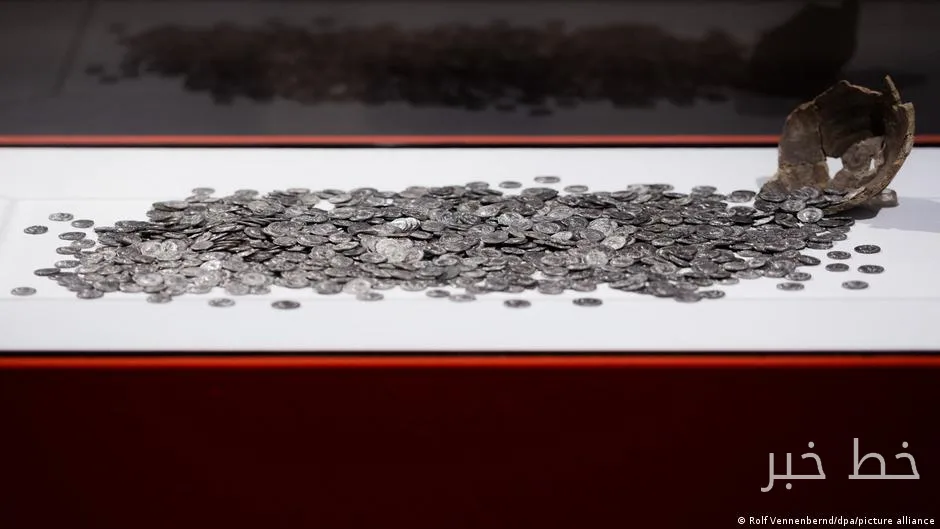
Oliver Riedel, an amateur archaeologist, has discovered the largest treasure of Roman silver coins in Germany. These coins belong to the second century AD and were found near Wesseling, south of Cologne.
Details of the Discovery
Riedel described the moment of the discovery of the coins, saying: "It was clear to me that something important was here." A year ago, after finding the coins, he contacted the authorities and requested assistance. A team of experts began excavating and ultimately discovered 934 coins known as "denarii."
Exhibition of the Treasure
This treasure was displayed on Tuesday at the LVR-LandesMuseum Bonn. According to local officials, this is the largest coin treasure from the time of the Roman Emperor Hadrian ever found in Germany. Archaeological officials in the region believe that these coins were likely buried during the second half of the second century AD.
Erich Klassen, senior archaeologist of North Rhine-Westphalia, said: "Of course, we can only speculate about the reasons for burying these coins, but someone probably wanted to keep this money safe. After all, there were no banks at that time." He also added that there is no explanation for why these coins were not discovered until now, and it is unclear who buried them. According to him, "Perhaps the owner died before he could recover them or pass on information about their location."
Historical and Economic Value of the Coins
Coin treasures from the Roman period and other historical periods are not uncommon in this region. However, according to officials, few discoveries from the second century are as extensive as the Wesseling treasure. The current value of this collection is hard to estimate, but it can be referenced due to the extensive documentation available in written sources.
At that time, an ordinary soldier earned about 300 denarii a year, and half of this amount was deducted for food and equipment expenses. Rahel Othe, a researcher at the state archaeology office, explained: "Therefore, a soldier would have to save all of his disposable income for about six years to be able to accumulate a treasure like the Wesseling treasure."
The Cologne region was under Roman control from around 39 BC to 459 AD. The Romans established their presence in this area on the orders of General Marcus Vipsanius Agrippa to secure the borders of the empire along the Rhine River, and in this context, they established a military base that later became Colonia Agrippina, which is present-day Cologne.