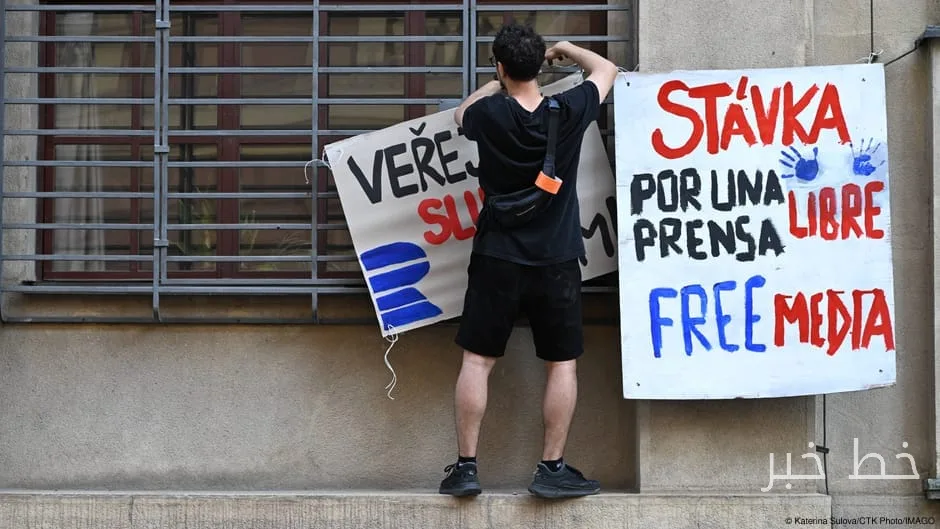
Hundreds of thousands will gather in Prague this weekend to protest the Czech government's efforts to pass a law that reforms the funding of public media. The government, led by right-populist Prime Minister Andrej Babiš, quickly pushed the bill through an unexpected parliamentary session in October, with voting for its approval taking place at 4:36 AM on October 24.
Details of the Proposed Bill
The bill has been accompanied by much controversy and has led to multiple protests and strikes across the country. The rally on Sunday in Letná Park in Prague is likely to be the largest protest event. According to the government's proposal, the licensing fee model currently funding Czech Television (CT) and Czech Radio (CRo) will be abolished, and these media will be directly funded from the state budget.
Read more: Peter Hegest met with his reprimanding soldier at Arlington Cemetery
The three parties in the coalition, including the centrist ANO party led by Babiš, the far-right SPD party, and the radical conservative Motorists' Party, believe that the licensing fee is an unfair tax. They claim that this new change will increase the efficiency of CT and CRo. They also point to similar models in several other European Union countries.
The Role of Media and Criticism of the Government
Criticism of these justifications has significantly increased. Opposition parties, civil society organizations, and international oversight bodies accuse the government of attempting to undermine media independence, which has always upset Babiš and the SPD due to their critical reporting. Analysts point out that while models in other EU countries include guarantees of financial stability and editorial independence, the Czech government's proposal offers none of these.
CT and CRo have warned that the proposed budget cuts will mean fewer programs and staff layoffs. Václav Stetka from the European Digital Studies Institute reacted to the initial release of the bill by stating that these "severe budget cuts represent a form of cultural destruction."
Protests against the limitations on parliamentary debate, while the bill is moving quickly, have also increased. Otto Eibl, a political scientist at Masaryk University in Brno, said, "The government's tense approach, efforts to limit parliamentary debate, and the tone of the government towards journalists and critics have all contributed to public backlash."
Reactions were swift and strong. Crowds gathered outside the parliament throughout the night, and protests began as the government advanced the first reading of the bill. Staff at CT and CRo announced a strike in early November, disrupting the country's television and radio programming.
This gathering takes place two days before the anniversary of the Velvet Revolution's start on November 17, which ultimately led to the fall of communism in Czechoslovakia. The civil society group "One Million Moments for Democracy," which is organizing the Sunday rally, previously brought hundreds of thousands to the streets in 2019 and again earlier this year during Babiš's premiership.
The government's sudden push to advance this proposal reflects their urgency to fulfill a promise made before the October 2025 elections. It also indicates the Prime Minister's long-standing desire to control the CT governing council, a goal he failed to achieve during his first term from 2017 to 2021.
Stetka states that the repeated attacks on public media by Czech governments reflect a specific political culture in post-communist European countries. "Political prime ministers will never accept the independence of public media," he emphasized.
In the Czech Republic, public media enjoy a special status and are recognized as pillars of democracy. This status was established during the Czech Television crisis of 2000-01, when the occupation of CT studios by staff and widespread protests forced the then-government to retreat from its attempts to exert control.
Eibl said, "The fight for public service media has become a symbol of the defense of liberal democratic values and institutions." With rising public anger, the government has tried to calm the situation. Babiš has announced that a new proposal for public media funding, which would ensure editorial independence, will be prepared.
However, critics remain unconvinced, pointing to the lack of sufficient details and the insistence of other government members to continue their course. One Million Moments for Democracy has emphasized that pressure must continue.
Currently, there are no signs of a decrease in protests, and the government faces a difficult choice. They have the parliamentary majority necessary to advance the bill and counter any potential vetoes from the Senate and President Petr Pavel. Polls indicate that political support for the government has weakened, and if protests expand into broader discontent over living costs and housing, it may weaken further.
Analysts warn that the real danger for the government is that the media issue could become a focal point for broader discontent.
Read more: Steve Witkoff and Jared Kushner will meet with Zelensky · Generation Z protests in Germany spark debate about integration and prejudice