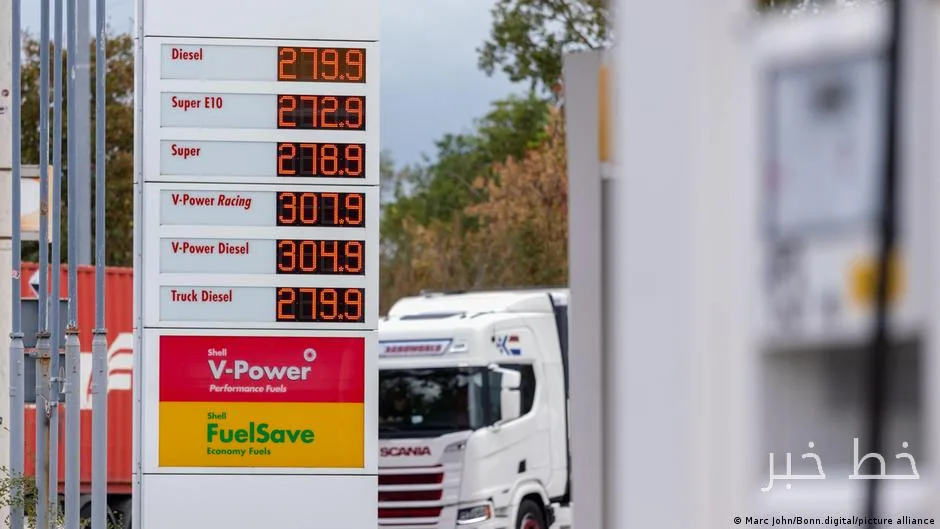
The German government is facing a serious challenge from rising fuel prices. On September 15, the price of E10 gasoline in Berlin reached about €2.25 (approximately $2.60) per liter, and the price of diesel rose to €2.37. By noon that day, prices had increased by about €0.20 per liter. The highest prices were recorded at a gas station on a highway south of Berlin, where the price of super plus gasoline reached €3.03 per liter.
Driver Reactions and Growing Discontent
Drivers have expressed their strong dissatisfaction with these price increases. While public transportation may be an option in large cities, residents of rural areas have no real alternatives to driving. Residents near national borders have advantages in this regard. On September 7, filling a 60-liter tank with E10 gasoline in the Czech Republic and Poland cost about €31 less than in Germany. In Luxembourg, this difference was €28, and in Austria, it was €25. These figures were calculated by the Federal Statistical Office of Germany.
Read more: Dangerous Signs in the Reform of the World Trade Organization
Government Actions and Chancellor's Statements
The German government is facing challenges from its 9 neighboring countries. Gasoline prices are significantly cheaper in seven neighboring countries, and diesel prices are lower in six other countries. Only in the Netherlands and Denmark do drivers pay more for fuel than in Germany.
However, there is soon hope for price reductions. This has been promised by Chancellor Friedrich Merz (CDU). At an event held by the German Foreign Trade Association (BGA) in Berlin, Merz said, "Many people who rely on their cars every day have reached their breaking point. I believe we need to take action." However, he added that "specific measures" have not yet been determined.
Merz also noted that the federal government is in close discussions with German states, and a proposal will be announced soon. Meanwhile, Stephen Meyer, a government spokesperson, denied any responsibility of the government for the price increases, stating: "These price increases are due to the critical situation in the Middle East, attacks on oil pipelines, and the blockage of shipping routes."
Analyses and Expert Opinions
The reality is that Germany imposes higher taxes and fees on fuels. The ADAC automobile club has pointed out that while oil prices remain below previous peaks, the price of E10 gasoline is experiencing its highest levels. An ADAC spokesperson stated: "From ADAC's perspective, there is therefore a need for greater transparency, especially regarding refining and wholesale markets."
Herbert Rabl from the Gas Station Interest Group (TIV) expressed this more bluntly, saying: "They are profiting. Oil companies have no reduction in their profit margins." This issue has long been a topic of political debate, and the federal government remains divided on what can be done.
The German government introduced a fuel subsidy in the spring due to rising oil prices following the outbreak of war with Iran. From May 1 to June 30, 2026, the energy tax on gasoline and diesel was temporarily reduced. Including value-added tax, this reduction was expected to lower fuel prices by about €0.17 per liter.
Federal Minister of Economics, Katharina Reich (CDU), said: "We had a fuel subsidy; we subsidized prices." But she said that this time it may not be possible: "We in the coalition have decided that we currently do not have the financial space for that."
As another option, conservative parties are considering the possibility of providing a minimum tax exemption for travelers or supporting low-income individuals with direct payments. However, this is not sufficient for the SPD. This party proposes a completely different approach and, like in the early days after the outbreak of the Iran war, calls for a price cap on fuel. One way to finance these aids is through a tax on the excess profits of energy companies.
Elections and Political Pressure
While the federal government continues to discuss and explore its options amid internal disagreements, other parties feel that time is running out. Regional elections will be held in two states on September 20. In Mecklenburg-Vorpommern, SPD Prime Minister Manuela Schwesig is trying to prevent a victory for the far-right Alternative for Germany (AfD). In the latest polls, AfD was leading with 38 percent, while SPD has recently made progress and now holds 34 percent.
The rise in fuel prices and public discontent have challenged the German government and highlighted the need for immediate action.
Read more: Edouard Philippe Ready to Introduce New Pension Reforms · Investment in SpaceX by Elon Musk Shapes a New Identity