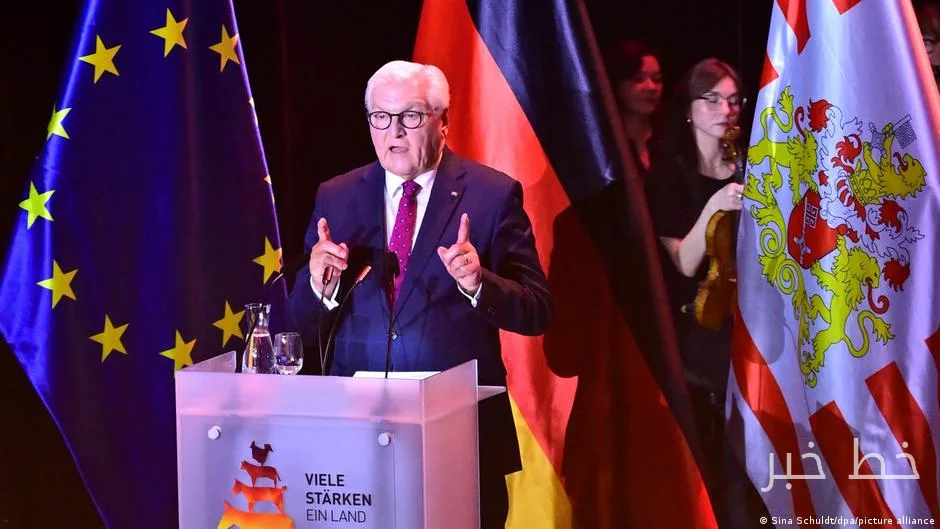
Frank-Walter Stanton, the President of Germany, spoke in his address on the occasion of German Unity Day about the new challenges threatening democracy in this country. He considered this event an opportunity to reflect on more than three decades of political changes in Germany and expressed his concerns about the rise of right-wing extremism.
Concerns about right-wing extremism
Stanton, who was speaking at the official German Unity Day ceremony in Bremen, referred to Germany's history and its lessons, stating: "I thought everyone had learned from history, but now I see that supporters of right-wing extremism are trying to erase the memory of the Holocaust victims." He also said: "I believed that our democracy was secure, and now we must face its challenges again."
The President of Germany, whose second and final term ends in March, referred to his expectations from the political changes that began in 1989, adding: "My expectations from these changes have exceeded reality." He pointed out the less-than-expected progress in liberal democracy and international cooperation, acknowledging that they have faced "bitter failures" along the way.
Call for maintaining social cohesion
Stanton, while referring to the challenges facing his successor, noted that the presidency "is not a position that can be looked at lightly" and added: "Promoting social cohesion and maintaining national unity will become a greater challenge in the coming years."
The German Unity Day ceremony began with a joint religious service at St. Peter's Cathedral in Bremen, attended by Stanton, Chancellor Friedrich Merz, and other senior officials. More than 550 events are being held in Bremen to commemorate the 36th anniversary of German unity, and these festivities will continue until Sunday.
National celebrations on German Unity Day are held across the country, with the main ceremonies taking place in Bremen. More than 400,000 people are expected to participate in the public festival in Bremen, which includes free concerts, discussions, guided tours, and exhibitions. The slogan of these celebrations is "Multiple Powers — One Country," and Bremen hosts the central event due to its rotational presidency of the Bundesrat.
More than three decades after unity, significant differences still exist between East and West Germany, including in income, wealth, and representation in high positions. In this context, Elizabeth Kaiser, the German government's commissioner for East Germany, has called for the election of a president from the eastern part of the country, stating that Easterners have less representation in positions of power.