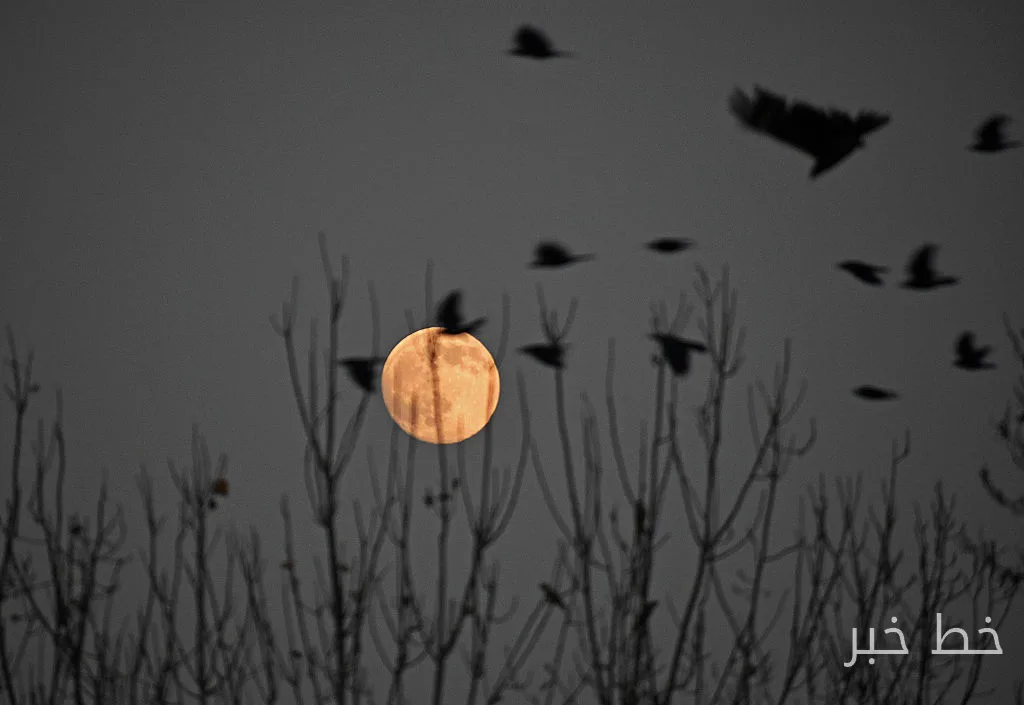
The supermoon will be visible in the sky from Monday to Wednesday, November 23 to 25. This phenomenon is known as an extraordinary full moon that can be seen both at night and during the day, although not as much as at night. This supermoon is the first of three consecutive supermoons, with the other two peaking on Christmas night and January 22.
Full Moon and Supermoon
A full moon occurs when the Earth is positioned between the sun and the moon, illuminating the entire visible hemisphere of the moon. In contrast, a new moon, or absence of the moon, occurs when the moon is positioned between the Earth and the sun in its orbit around the Earth, causing its far side to be illuminated. However, not all full moons are the same.
Read more: Exploring the Mysteries of the Parthenon by a German Archaeologist
The moon's orbit around the Earth is elliptical, and its distance from Earth varies between its closest and farthest points. The closest distance, or perigee, is about 223,000 miles, while the farthest distance, or apogee, is about 252,000 miles. The average distance of the moon from Earth is approximately 239,000 miles. A full moon can occur at any point in this ellipse, significantly affecting what we see. A full moon at apogee, known as a micro moon, appears about 7% smaller than an average full moon at the average distance of 239,000 miles and 14% smaller than a full moon at perigee, where the supermoon occurs. Additionally, a supermoon can be up to 30% brighter than a micro moon.
Experiencing the Supermoon
Neil deGrasse Tyson, the famous astronomer, commented on the experience of the supermoon in 2022 on platform X, stating, "The full moon tonight, the biggest moon of the year, is 8% larger than an average full moon. Some call it a 'super duper moon.' I have no problem with that, but only if you think a 16-inch pizza is bigger than a 15-inch pizza."
However, despite the criticisms, there is still much to see. The peak experience of the supermoon occurs when the moon is near the horizon, appearing significantly larger than when it is directly overhead. If you extend your arm and hold your finger against the size of a large moon on the horizon, the result will be no different than when the moon is overhead. But convincing your eyes of this reality is not an easy task.
This phenomenon, which NASA refers to as the "moon illusion," is a topic that astronomers and sky enthusiasts have debated for centuries, with various explanations offered. One theory is that when the moon is near the Earth, we subconsciously compare it to smaller objects like trees, houses, and cars, making it appear larger. Whereas when the moon is overhead, there is nothing to compare its size to except the vast sky, making it seem smaller. Additionally, when the moon is low in the sky, its light has to travel about three miles further to reach us, causing more blue light to scatter and more red and yellow light to reach us.
The next supermoon will peak at 9:53 AM Eastern Time, after sunrise, and therefore is not ideal for viewing. However, there will be plenty of opportunities to see it at night over the three days.
Finally, regarding the name of this supermoon, full moons typically have traditional names such as "Wolf Moon" in January and "Worm Moon" in March. This upcoming full moon is known as the "Beaver Moon," signifying the cold season when beavers head to their lodges. It is also referred to as the "Hunting Moon" and the "Deer Mating Moon," but perhaps it is best to simply call it "Beautiful" and enjoy watching it.
Read more: Vote for Raya and Rosalía's Prominent Presence at the Grammy Awards · Possible Disruptions in Thanksgiving Travel Due to Inclement Weather