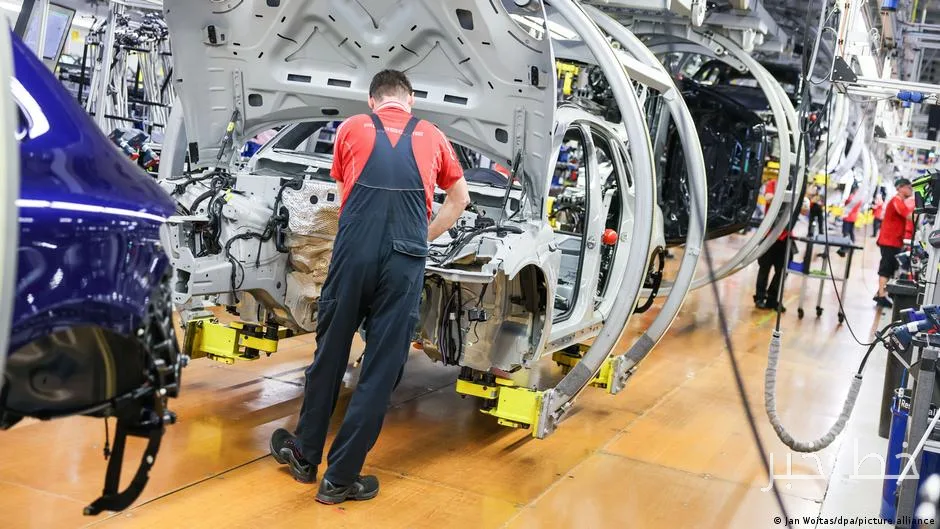
The automotive industry in Germany is facing a serious crisis due to high production costs, heavy tariffs from the U.S., increasing competition from China, and the difficult transition to electric vehicles.
Production Cuts and Layoffs
Major companies like Volkswagen, Mercedes-Benz, and BMW have announced plans to cut production and reduce costs. This industry is losing jobs at a faster rate than any other industrial sector in the country. For example, Volkswagen intends to reduce about 15 percent of its global workforce, equivalent to 100,000 jobs, by the end of the decade. BMW has also announced that it will cut up to 8,000 jobs, about 5 percent of its workforce, by the end of 2027.
Read more: 43 percent of Americans hold Trump responsible for the current state of the economy
Challenges of Labor Costs
Automotive suppliers like Bosch and ZF Friedrichshafen have also reduced thousands of jobs amid tough market conditions and global competition. Ferdinand Dudenhöffer, director of the Center for Automotive Research in Bochum, stated that the automotive industry in Germany is losing its competitiveness, and high production costs are leading to a shift of production abroad.
According to Dudenhöffer, the average labor cost in Germany is $3,307 (€2,882) per vehicle, which is significantly higher compared to $769 in Japan and $597 in China. To reduce labor costs, automakers are seeking to increase employees' working hours to 40 hours a week instead of the current 35 hours, without raising wages.
The 35-hour workweek in the automotive industry in Germany originated from collective agreements in the 1980s and 1990s. Labor unions strongly oppose increasing working hours, and Christiane Benner, head of the IG Metall labor union, stated that workers have already accepted wage cuts and other concessions, and now they are being told that this is not enough.
Benner stated that German automakers are facing weak demand and insufficient factories, not a shortage of working hours. Therefore, increasing working hours will not lead to more car sales.
Dudenhöffer emphasized that Germany can only be a viable option for the automotive industry and jobs if it regains its competitiveness. He also pointed out that this recovery requires difficult reforms in various areas.
Read more: Review of the Silicon Valley Bank failure shows that the Federal Reserve was aware of the risks · Greg Stanton warned about new threats to American jobs