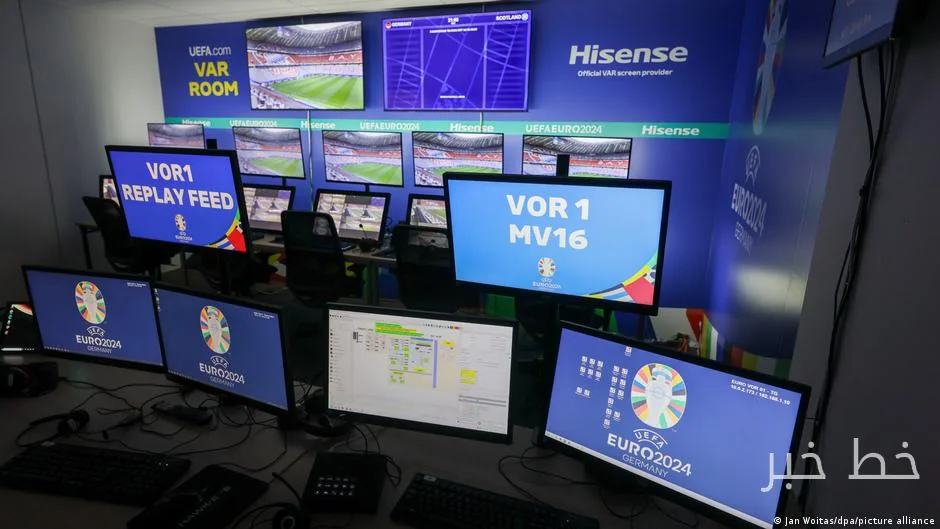
VAR technology (Video Assistant Referee) has become one of the most debated topics in football. This technology, approved by the International Football Association Board (IFAB) in 2012, has only entered the world of football for a decade, while it has long been used in other sports such as American football, rugby, and cricket.
New Expectations from VAR
With recent advancements in technology, especially in the field of artificial intelligence, it is a good time to pay attention to the role of this technology in sports. Has VAR transitioned from a supporting role to a decisive and game-changing role? Sossmit Gulavani, a professor at the University of South Carolina and an expert in artificial intelligence and machine learning in sports, points out that the primary task of VAR was to reduce human error in decision-making, while the referee still remained at the helm of decisions.
Read more: Replacement of Germany's number one goalkeeper after Manuel Neuer's retirement
However, over time, the use and impact of VAR have increased, and the introduction of new technologies such as semi-automated offside technology (SAOT) has accelerated this trend. While these advancements have improved the accuracy of offside decisions, they have also raised expectations for achieving flawless results.
Challenges Arising from Dependence on Technology
Gulavani states that this expectation somewhat refers to a sense of "mission creep." VAR is now expected to resolve almost every controversial decision, while many cases, such as fouls or handball decisions, still require human interpretation. This search for perfection often keeps fans waiting and confused, disrupting fast and fluid games.
We witnessed this issue in the recent World Cup. However, it seems that this technology is finding more ways to penetrate the world of football. After the World Cup, German officials confirmed that VAR could also play a role in decisions regarding second yellow cards and corner kicks in the Bundesliga. This decision faced significant criticism from fan groups in the country, who launched a coordinated campaign to eliminate VAR, stating that this technology has "stolen the joy of football" and that it is time to return the cameras to the box.
This issue is particularly significant in Germany, where many fans are club members and thus have a real impact on club decisions and game management. Yoshen Dries, the head of VAR operations in Germany, has, however, pointed to promoting technological improvements rather than eliminating it, which seems to be a natural inclination.
Gulavani explains that "VAR is a useful example of a broader social pattern. As technology advances, we are increasingly dependent on it, but we must decide where its role begins and ends."
Given that VAR technology is likely to be inevitable in the future, there may be a need for a different system. In last year's Under-20 World Cup, challenge cards, similar to the NFL, were tested. Coaches could request reviews of situations, which reduces the interference of continuous replays and slow evaluations. This approach, officially known as Football Video Support (FVS), is still being tested but is likely seen as a cheaper alternative to costly VAR.
Gulavani emphasizes that "the key is to envision technology as a support for decision-making, not as a replacement for it." While technologies like VAR perform well in processing large amounts of information quickly and continuously, they cannot fully understand the context, intent, or nuances that many sports decisions require. Human referees are still needed to interpret the rules of the game and apply judgment in situations where there are no objective 'correct' answers.
Returning to a previous era seems impossible, but the challenge remains. Can sports find a way to restore technology to a supporting role without eliminating human interaction and feeling? If it can, perhaps these waves will be felt beyond the white lines of sports.
Read more: Aaron Judge helped the Yankees reach the playoffs with his first homer · Politicians' dispute over antitrust exemptions for artificial intelligence companies