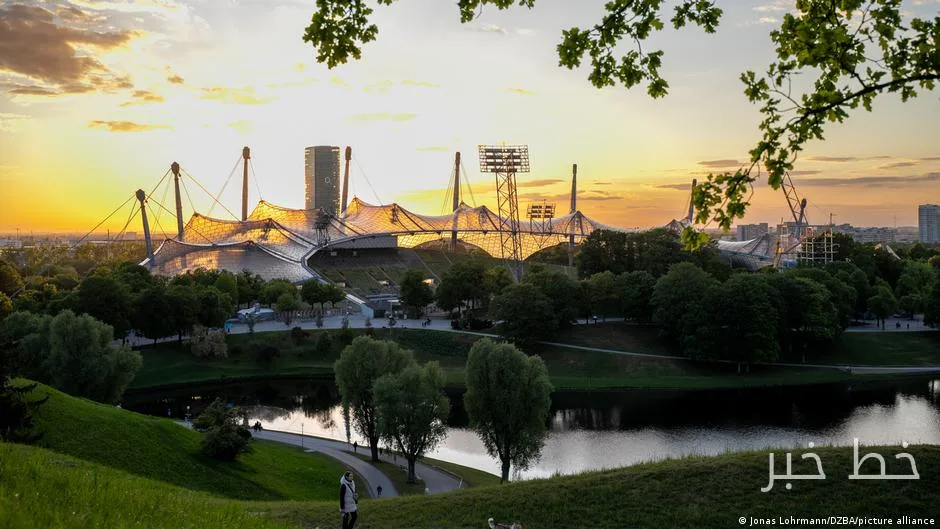
Germany hopes to secure the hosting rights for the Olympics in 2036, 2040, or 2044. On Saturday, the German Olympic Sports Confederation (DOSB) is set to vote to select one of the three proposals (Munich, Cologne-Rhine-Ruhr, and Berlin).
Munich's Proposal and Its Advantages
The slogan for Munich's bid to host the Olympics is "For the Games with Heart and Soul." This concept focuses on sustainability, with the Olympic Park from 1972 considered its central point. According to documents released by the bidding committee, about 90 percent of the competition venues are located within 30 kilometers of the Olympic Village. Most of the venues to be used already exist, and only a few temporary facilities will be constructed.
Read more: A man in Idaho breaks the world record for throwing cups
In addition to existing infrastructure, other advantages include Munich's experience in hosting major sporting events and its Olympic legacy since 1972. Organizers aim to present an alternative model to the costly Olympic projects of the past.
Political support for Munich's bid is strong. Dominic Krause, the mayor of Munich, states on the city's website: "In Munich, we have the ideal conditions to host the Summer Olympics and Paralympics." He also added that hosting the Olympics in Munich is an investment in the future.
The Situation in Berlin and Cologne-Rhine-Ruhr
The situation in Germany's capital is different. The Left Party (Die Linke) gained the most votes in the elections on Sunday in Berlin, and Elif Arap, the party's leader, could be elected as the new mayor of the state. She has explicitly opposed the idea of bringing the Games to the capital, describing it as "a waste of taxpayer money." The Green Party, which could be a coalition partner for Arap, is also against the Olympic bid.
Berlin's proposal primarily emphasizes the use of existing sports facilities for the Games. Kaveh Nirvand, the Olympic Commissioner for Berlin, told the newspaper "Die Welt": "Ninety-seven percent of the required sports facilities already exist. Except for one private arena, there is no need to build new venues."
The third proposal encompasses a complete region that includes several scattered venues. Cologne acts as the "main city" in this proposal, which includes 15 municipalities in the state of North Rhine-Westphalia. Cologne will host the Olympic Village and a temporary athletics stadium.
Organizers emphasize that all venues either already exist or will be temporary, and 66 percent of those who voted in the April referendums in the relevant municipalities supported this proposal.
A total of 144 votes will be available in the voting on Saturday. The Olympic sports federations of Germany, which include winter sports federations, along with a 10-member executive board of the DOSB and eight individual members of the DOSB, have voting rights. Each sports federation has three votes separately.
If none of the three proposals receives an absolute majority in the first round of voting, the last proposal will be eliminated in the second round, and thus the final decision will be made after a maximum of two rounds of voting.
The final report of the DOSB evaluation committee introduced Munich's proposal as the slightly more popular option with a score of 87.03 out of 100, while Cologne-Rhine-Ruhr scored 85.02 and Berlin 74.64.
This is just one more step in the long decision-making process regarding who will host the next three editions of the Summer Olympics. The International Olympic Committee will not make the final decision on the hosting of the 2036 Olympics until 2029.
Read more: Jared Goff and Jaden Daniels among the top five fantasy quarterbacks of week two · Caleb Williams is in a week-to-week status due to a hamstring injury