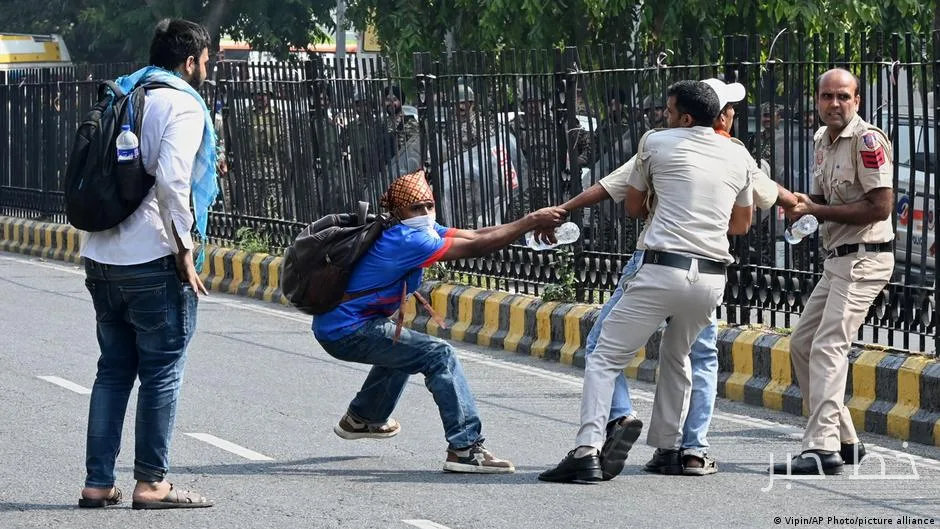
The Indian government responded to the Insect protests of the Janata Party (CJP) in New Delhi and arrested many opposition leaders. These protests arose out of concerns regarding electoral list reforms and allegations against Prime Minister Narendra Modi's government.
Arrest of Opposition Leaders
In these protests, Arvind Kejriwal, leader of the Aam Aadmi Party and former Chief Minister of Delhi, and Mamata Banerjee, who has lost her power as Chief Minister of West Bengal, were arrested. Additionally, Pinarayi Vijayan, a communist leader and former leader of Kerala, was also among those detained.
Read more: An earthquake of 7.7 magnitude shook Panama
Criticism and Reactions
Opposition leaders, including Rahul Gandhi, described the government's action as cowardly and identified various officials, including Prime Minister Narendra Modi and Home Minister Amit Shah, as the "villains of this story." Priyanka Gandhi Vadra, Rahul Gandhi's sister, wrote in a social media post that "India is no longer a democracy" and appears to be governed under a dictatorship.
Opposition parties and critics have expressed concerns about the electoral list reforms, believing that these reforms may disenfranchise millions and give an advantage to the ruling Bharatiya Janata Party (BJP).
Heavy Security Presence
In the wake of these protests, tens of thousands of security forces were deployed on the streets of Delhi, and roads were blocked to prevent the protests from taking place. Police have arrested thousands of protesters, and some CJP leaders, including Abhijit Deepak, were detained before entering the capital.
The CJP group has urged people to fill out an online form immediately if they believe they or someone they know has been unlawfully detained.
India ranked 157th out of 180 countries in the 2026 Press Freedom Index, and press freedom groups have expressed concerns about the use of criminal laws against journalists.
Read more: Trump goes to New York for midterm campaign · Narendra Modi celebrates 25 years as Prime Minister