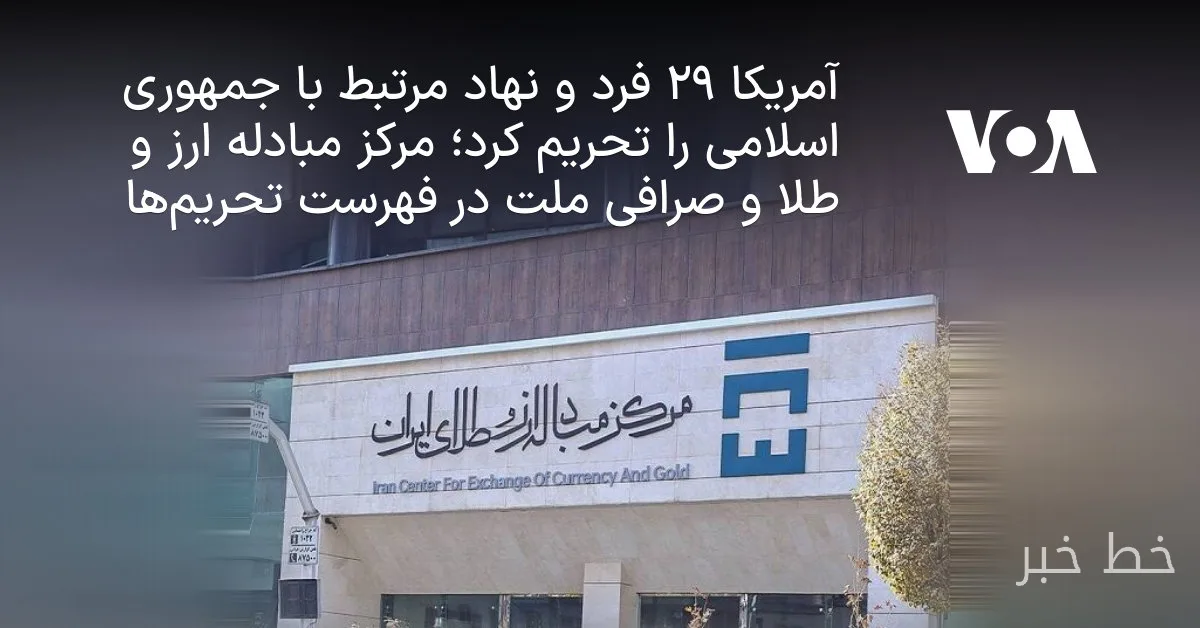
On Monday, December 2, the U.S. Department of the Treasury added the names of eight individuals and 21 companies and entities linked to the Islamic Republic to its sanctions list. The Currency and Gold Exchange Center of Iran, Mellat Exchange, and several companies based in the United Arab Emirates are among the targets of the new sanctions.
Details of the Sanctions
According to a notice from the Office of Foreign Assets Control of the U.S. Department of the Treasury, these sanctions have been imposed under executive orders related to the Islamic Republic and countering terrorism financing. One of the most significant sanctioned entities is the "Iran Currency and Gold Exchange Center," which was established in April 2023 and is considered an active player in Iran's official currency and gold market.
The U.S. Department of the Treasury also added the names of "Mellat Exchange Company," "Mina Feshki Exchange Company and Partners," and "Nasim Baharan Qeshm Trading Leader Company" to the sanctions list. Eight sanctioned individuals are also linked to these three companies. Mohammad Hossein Abbasi, Mahmoud Akhlaqi, and Parviz Fazlajoo are associated with Mellat Exchange, Mina Feshki and Farzad Feshki are linked to Mina Feshki Exchange Company and Partners, and Valiollah Hemmati, Seyed Mohammad Jalali, and Ali Kalhor are connected to Nasim Baharan Qeshm Trading Leader Company.
Impact of the Sanctions
A significant portion of the new sanctions targets companies operating outside of Iran. Of the 21 sanctioned companies and entities, 14 are registered in the United Arab Emirates, primarily in Dubai. Additionally, one company based in Turkey and one registered in Hong Kong are included in the new sanctions list.
The targeted companies operate in areas such as general trade, raw materials, industrial equipment, machinery parts, energy, and commercial activities. In the OFAC notice, many of these individuals and companies are also mentioned as being at risk of secondary sanctions; an issue that could expose financial institutions and non-U.S. companies dealing with them to U.S. sanctions actions.
Being placed on the OFAC sanctions list typically means the blocking of assets and financial interests of the sanctioned individuals within the jurisdiction of the United States and a prohibition on U.S. persons from engaging in transactions with them unless authorized or exempted.
The new sanctions are part of the U.S. Department of the Treasury's ongoing efforts to limit the Islamic Republic's access to the international financial system and its related financial networks. The U.S. Department of the Treasury had previously announced that intermediary financial networks and shell companies are among the tools used to conceal the connection of international transactions with the sanctioned entities of the Islamic Republic.
Scott P. Amey, the U.S. Secretary of the Treasury, had also previously emphasized that the Trump administration would continue to cut off the financial lifelines of the Islamic Republic and counter its efforts to evade U.S. sanctions.
Read more: The European Commission has launched antitrust investigations into Coca-Cola bottler · The Trump administration intensifies economic pressure on Iran with Operation Iron Gate



