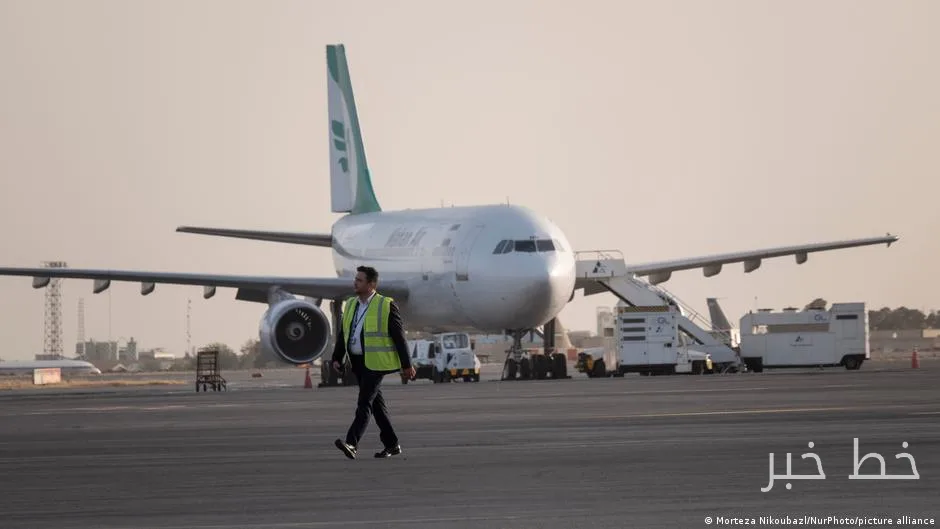
U.S. sanctions on Iran's aviation industry have further damaged this sector and made international travel unpredictable. These sanctions also bring new risks for trade and cargo.
New Challenges for Air Travel
In early September, the U.S. Department of the Treasury imposed sanctions on Iran's aviation industry as part of "economic expulsion operations." These sanctions target Iranian airlines and companies that provide ground services, ticket sales, or airport support, facing the risk of secondary sanctions that may limit their access to the U.S. financial system.
Read more: UK Business Secretary Warns of Possible Ban on U.S. Diesel Exports
The United States cannot directly ask foreign airports to refuse Iranian aircraft. However, the threat of secondary sanctions can increase the risk for airports, fuel suppliers, and airlines in servicing these planes.
Effects on Passengers and Cargo
For Tehran, the aviation sanctions are another layer of broader pressures from Washington, which include banking, maritime, insurance, and trade restrictions. Washington claims that Iranian airlines serve not only civilian passengers but also military and security networks. For instance, Mahan Air has been accused of supporting the Islamic Revolutionary Guard Corps.
This issue has also been discussed within Iran. Mohammad Javad Zarif, the former foreign minister, stated in an interview that Qassem Soleimani used civilian aircraft to transport forces and equipment to Syria. For Washington, such connections help justify targeting airline networks.
However, the immediate result for ordinary passengers is flight cancellations and reduced options for leaving or returning to the country. Iranian flights to Baghdad and Muscat have been suspended or canceled, and the countries of Azerbaijan and Georgia have also stopped flights from Iranian airlines.
An Iranian travel agency reported that air routes to Oman, Iraq, Azerbaijan, and Georgia have been severely disrupted. On September 24, Turkmenistan denied permission for an Iranian plane to fly from Tehran to Dushanbe over its airspace, forcing the aircraft to return to Iran.
Although Turkey, Armenia, and China have not announced any general restrictions, passengers are increasingly reluctant to buy tickets as even a confirmed reservation does not guarantee a flight.
According to a passenger, agencies are still selling tickets but cannot guarantee that the flight will actually take place. As part of the sanctions package, the U.S. has also suspended the general "J-1" license that allowed certain non-Iranian aircraft to make temporary stops in Iran under specific conditions.
The new sanctions have increased legal and financial risks for airlines, airports, fuel suppliers, and service providers. Now they must calculate the risk of secondary sanctions.
With rising uncertainty in air connections, more passengers have turned to crossing land borders. One passenger whose flight was canceled traveled overland from Iran to Turkey and then continued to Istanbul by plane. He said, "The border was very crowded. Many people were trying to leave because they were worried that routes would close."
For families, elderly travelers, students, and patients, crossing land borders and continuing travel by road and air can be much more difficult than a direct flight. Costs are also rapidly increasing as travelers add road transport, accommodation, and additional flights to journeys that previously required only one ticket.
Moreover, air cargo that is crucial for urgent or sensitive goods, including certain medications and medical equipment, industrial components, and laboratory samples, has been affected. This issue becomes more critical as Iran simultaneously faces severe restrictions on maritime trade.
Iran's aviation industry was already facing structural problems before the recent sanctions. The Minister of Transport, Farzaneh Sadighi, had previously confirmed that some flights are conducted without radar guidance, placing more responsibility on pilots.
An aging fleet, difficulties in obtaining spare parts, years of sanctions, and a decreasing number of operational aircraft have all put pressure on airlines. When passengers also have to consider airport service acceptance, long delays, or flight cancellations without notice, buying a ticket becomes a calculation of risk.
Alireza Salavati, a political economy analyst and CEO of a London-based analytical firm, stated that the loss of air connections is unlikely to cause immediate significant damage to Iran's GDP. "Iran's aviation industry is small by regional standards. Unlike Turkey or the UAE, the country is not a major international hub, and its commercial fleet is limited."
Salavati added, "More damage is observed in connectivity. For a heavily sanctioned economy, flights are still important for trade, the diaspora, students, skilled workers, and medical treatment abroad." If primary connections disappear, Iran's international air network may gradually be limited to a few.
Read more: John Healy Faces Tax Challenge at Labor Conference · Trump Administration Has Halted Iranian Refugee Rescue Program