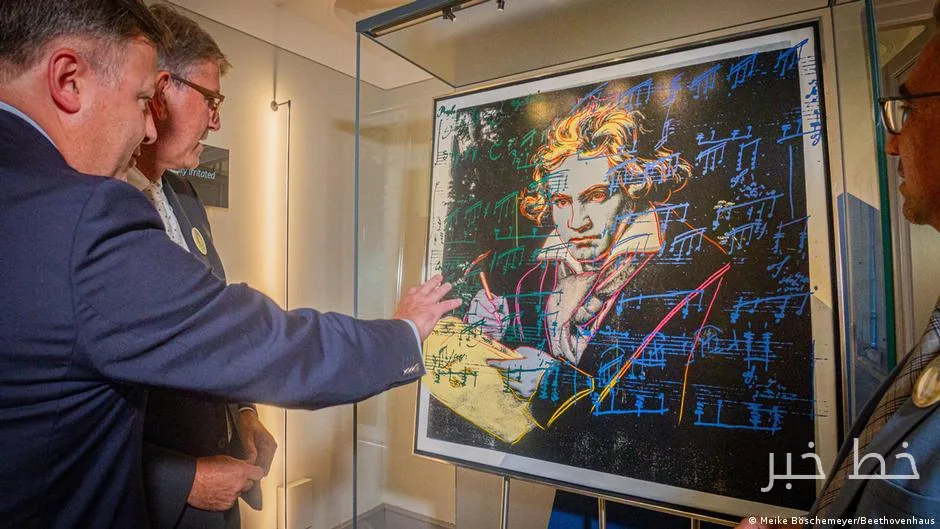
Andy Warhol presents a fresh and modern perspective on the great composer Ludwig van Beethoven through a portrait. In Warhol's silkscreen work created in 1987, vibrant colors and an engaging visual language are used to transform Beethoven into a modern icon.
History and Works of Warhol
This work was initially designed as a commercial piece for Warhol's studio in New York, known as 'The Factory', and was produced in a limited edition of only 60 copies. This image is considered one of the most innovative artistic interactions with Beethoven in the twentieth century. Warhol created these works just a few weeks before his sudden death on February 22, 1987, and this series became one of his last works.
Read more: Uncertain future of the Kennedy Center after being closed by Trump
Exhibition 'Beethoven as interpreted by Warhol'
The exhibition 'Beethoven as interpreted by Warhol', which runs until April 2027 at the Beethoven House in Bonn, explores Warhol's approach to the subject of Beethoven and the various contexts of his colorful works. This exhibition showcases rare works that visitors would typically not have the opportunity to see. The team of curators, led by Malte Becker, extracted these valuable works from deep within archives and private collections over three years.
Alongside Warhol's famous image of Beethoven, visitors can view sketches that the artist created in search of the Beethoven motif in Bonn. Additionally, there are print samples that document his exploration of colors in this series. The curators refer to a carefully designed print on canvas that belongs to an anonymous collector from the Rhineland.
According to Silke Bettermann, one of the curators of the exhibition, 'Warhol tells us: Look! This man, Beethoven, is completely modern! He is a superstar!'
Artistic Background of Warhol
When something seems easy and effortless, there is usually a lot of work behind it. This is true for Warhol's series on Beethoven as well. In the research process, Warhol compared several images of the composer and then developed his concept. He also created sketches based on Beethoven's likeness, including a statue of the composer in Münsterplatz in Bonn.
Ultimately, Warhol decided to base his work on an iconic portrait commissioned by Joseph Karl Stieler in 1820 from a couple in Frankfurt. This portrait attempted to capture not only Beethoven's appearance but also his rebellious character.
Warhol utilized the graphic design of Stieler's work, altered its colors, and placed Beethoven's musical notes on it. However, instead of using the 'Credo' notes from 'Missa Solemnis', he turned to the music of the 'Moonlight Sonata', which is arguably Beethoven's most famous work. Silke Bettermann states in this regard, 'Warhol speaks to us through his music.'
Warhol's dealer in Bonn, Hermann Wonsch, played a key role in creating Warhol's Beethoven works. He not only traveled to New York but also brought Warhol to the Rhineland several times. Thanks to Wonsch, Warhol created many works related to Germany, including portraits of Chancellor Willy Brandt and football star Toni Schumacher.
In the exhibition, Schumacher's work has been loaned from the private collection of this player to Bonn. Schumacher sat as a model for Warhol in 1983 and recalls this experience as one of the impactful moments of his life.
For the first time at the Beethoven House, a unique collection of record covers designed by Warhol is on display. These covers include beautiful works that Warhol designed for over 50 records throughout three decades.
This exhibition serves as an introduction to an important event at the Beethoven House. In March 2027, people around the world will commemorate the 200th anniversary of Beethoven's death with a special festival.
Wolfgang Wimmer, Commissioner for Culture and Media of Germany, traveled to Bonn as a supporter of this exhibition and spoke at the opening ceremony. In his speech, he said, 'Today we need more Beethoven. Beethoven was not only a musical genius who amazed the world with his greatest artistic works, but he also embodied freedom. He was a rebel who broke norms and questioned the power structures of his time. This message of freedom is also good for us today. We too need more freedom!'
Read more: Directors like Sinead Milhar and Dominic West join the war series · Wolfgang Tillmans recognized as one of the most prominent contemporary photographers