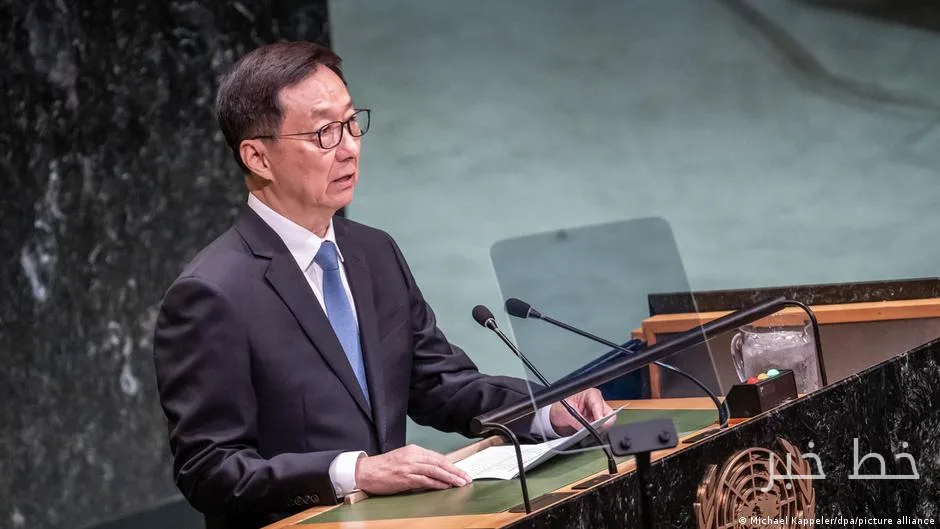
Han Zheng, the Vice President of China, emphasized the need to reject "unilateral military actions" in his speech at the UN General Assembly, noting that these actions not only lead to violations of the UN Charter but also occur by circumventing Security Council authorization. This statement specifically refers to the United States' attack on Iran.
Respect for the Sovereignty of Middle Eastern Countries
Han Zheng further stressed that the sovereignty and security of Middle Eastern countries, including those bordering the Persian Gulf, must be respected. He also called for the preservation of industrial and global supply chain stability and the protection of global trade. These remarks come amid rising tensions in the Middle East due to U.S. military policies.
Read more: Storm Nolu skirts Hawaii but brings heavy rainfall
Criticism of the Cuban Blockade and Palestinian Issues
In another part of his speech, Han referred to the Cuban blockade and, without naming the United States, urged the "relevant country" to lift this blockade and refrain from threatening the island nation with force. He also emphasized the need to restore the two-state solution for Palestine and called for immediate action in this regard.
As the sessions of the UN General Assembly continue, various countries have expressed their views on global issues. On the fifth day of this assembly, China and Germany were among the main countries addressing this event.
On this day, several small island nations also called for global attention to the climate change crisis. These countries highlighted their high vulnerability to the impacts of climate change in their speeches and called for increased funding to tackle this crisis.
Prime Minister Tenga, Fata Fehi Fakafanua, stated that Pacific leaders have been warning about the climate crisis for years but have yet to receive support. He questioned why the world has not taken action, despite the clear message of climate change.
Meanwhile, the Prime Minister of Pakistan, Shahbaz Sharif, attacked India in his speech, claiming that his country is facing external aggression under a "fabricated backdrop" from India. He emphasized that Pakistan has the right to self-defense under Article 51 of the UN Charter and claimed that his armed forces have been able to repel India's attack.
Sharif also praised the decisive and visionary leadership of former U.S. President Donald Trump, stating that this leadership prevented an all-out war in South Asia. He stressed the need for a fair and just resolution of the Kashmir issue to prevent a recurrence of such a situation.
At the end of the session, India also responded to Pakistan's statements and reacted to terrorism allegations against the country. In this context, Pakistan was accused of "exporting terrorism and violence."
Read more: Trump expressed condolences on the passing of Jim Copenhaver · Nepal's Prime Minister warned about the consequences of climate change