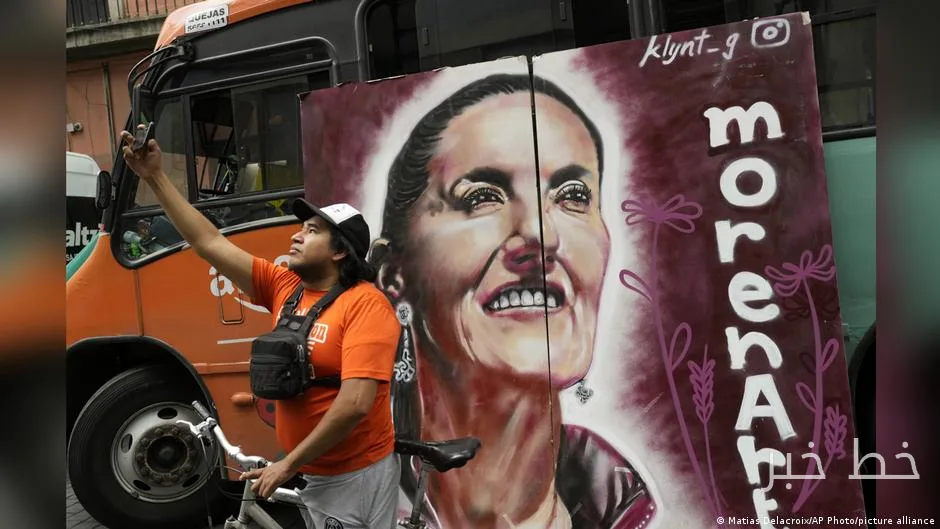
Since taking office as the first female president of Mexico in 2024, Claudia Sheinbaum has largely adhered to the political agenda of her predecessor, Andrés Manuel López Obrador. However, she has also encountered issues beyond Mexico's borders: violence from drug cartels, tens of thousands missing, and increasing political pressure from U.S. President Donald Trump.
Development of the Security Situation
In her second government report released in September, Sheinbaum announced a 51% reduction in the daily homicide rate since 2024. However, the extent to which this progress can be attributed to Sheinbaum's administration is a matter of debate. The Mexican Institute of Human Rights and Democracy has also noted improvements in reducing homicides, but the Mexico Ahora Institute has pointed to a lack of statistical evidence to attribute this decrease to Sheinbaum's actions.
Read more: Significant Decrease in the Workforce of the U.S. Department of Justice Amid Increasing Case Load
Other Challenges and Corruption
While Sheinbaum has reported a decrease in homicides, other statistics show a concerning trend. According to Mexico Ahora, the number of recorded kidnappings and enforced disappearances has increased by 127% over the past decade. By June 2026, national records indicated 135,271 missing persons, up from about 115,000 at the beginning of Sheinbaum's presidency.
Eduardo Bohórquez, director of the civil organization “Transparencia Mexicana,” has reported a change in the government's strategy to combat corruption, citing the “Operation Anjamb” in which over 100 government officials were arrested. Criticism has also been directed at the government's selective approach, as none of the current or former governors of the ruling party Morena have been prosecuted for corruption.
Sheinbaum has also announced a package of reforms to combat corruption, which will need to demonstrate whether her government will truly take a different path from its predecessors.
In terms of domestic and foreign policy, Sheinbaum is facing increasing pressures from Donald Trump and his administration regarding cartels, immigration, and trade. She has strongly opposed any military action by the United States on Mexican soil and has called for cooperation without dependency.
At the same time, cooperation on immigration has tightened, and between 2024 and 2025, the number of migrant encounters recorded by U.S. officials at the Mexico-U.S. border has decreased by over 84%.
Read more: Judge Did Not Set a New Date for the Trial of Lindsey Clancy · UN Security Council Extends Mission of Anti-Gang Force in Haiti