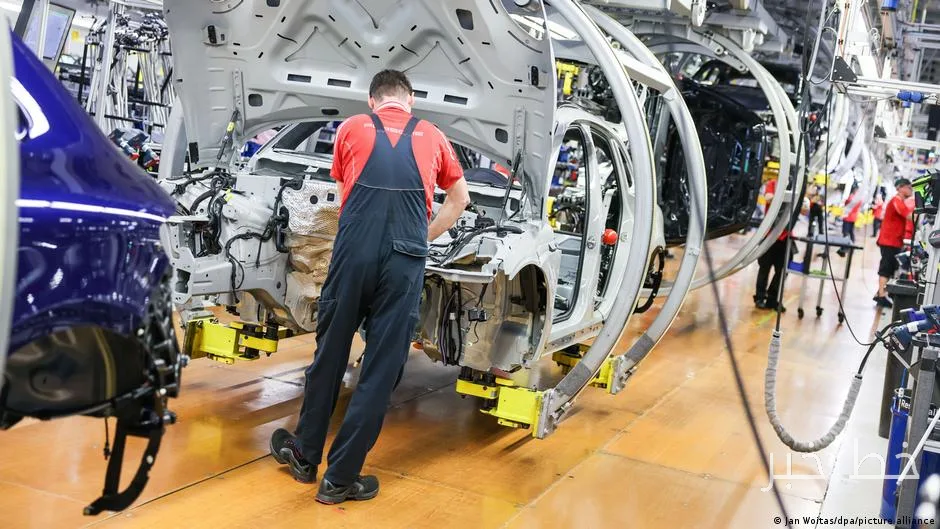
The German automotive industry is facing a deep crisis due to rising production costs, heavy tariffs from the United States, increasing competition from China, and the transition to electric vehicles. Major companies such as Volkswagen, Mercedes-Benz, and BMW have announced plans to reduce production and costs.
Job Numbers are Declining
This industry is experiencing the fastest job losses among other industrial sectors in the country. Volkswagen is looking to cut about 15 percent of its global workforce, equivalent to 100,000 jobs, by the end of this decade. BMW has also announced that it will reduce up to 8,000 jobs, equivalent to 5 percent of its workforce, by the end of 2027.
Read more: 43 percent of Americans blame Trump for the current state of the economy
Automotive suppliers like Bosch and ZF Friedrichshafen have also reduced thousands of jobs due to tough market conditions and global competition.
Competitive Challenges and Labor Costs
The automotive industry in Germany is losing competitiveness due to rising costs and the relocation of production abroad. Ferdinand Dudenhöffer, director of the Car Research Center in Bochum, stated that in 2018, this industry employed about 830,000 people, which has now dropped below 700,000, and it is expected to decrease to 500,000 by 2030.
Industry managers believe that labor costs in Germany are significantly higher compared to international competitors. The average labor cost in Germany is $3,307 (€2,882) per vehicle, while in Japan it is $769 and in China it is $597.
To reduce labor costs, automakers are calling for an increase in working hours from 35 hours to 40 hours a week without raising wages. The 35-hour workweek is a standard that originated from collective agreements in the 1980s and 1990s.
Union Opposition and the Future of the Industry
Labor unions strongly oppose the increase in working hours. Christiane Benner, president of the IG Metall union, stated that workers have already accepted cuts in wages and other benefits worth several billion euros, and now they are being told that this is not enough.
The union believes that German automakers are facing weak demand and underutilized factories, not a shortage of working hours. Dudenhöffer believes that if automakers switch to a 40-hour workweek, personnel costs will decrease by 13 percent.
Stefan Bratzel, head of the Automotive Management Center in Bergisch Gladbach, said that the 35-hour workweek is a significant achievement for unions in the history of collective bargaining, and thus a "conflict is inevitable." However, longer working hours for the same pay reduce labor costs per hour.
Experts believe that improving labor costs at German production sites is essential, but this alone will not solve deeper structural problems. Bratzel emphasized that to regain competitive advantage, German automakers must offer more attractive and affordable electric vehicles and invest in software and artificial intelligence.
Dudenhöffer also stressed the need for tough but necessary reforms, stating that Germany can only be a viable option for the automotive industry and its jobs if it regains its competitiveness. He warned that the coming years will be very challenging, and if we cling to the status quo, the situation will become even worse.
Read more: 17-cent drop in gasoline and diesel prices in Germany · Germany reduces fuel tax due to rising prices