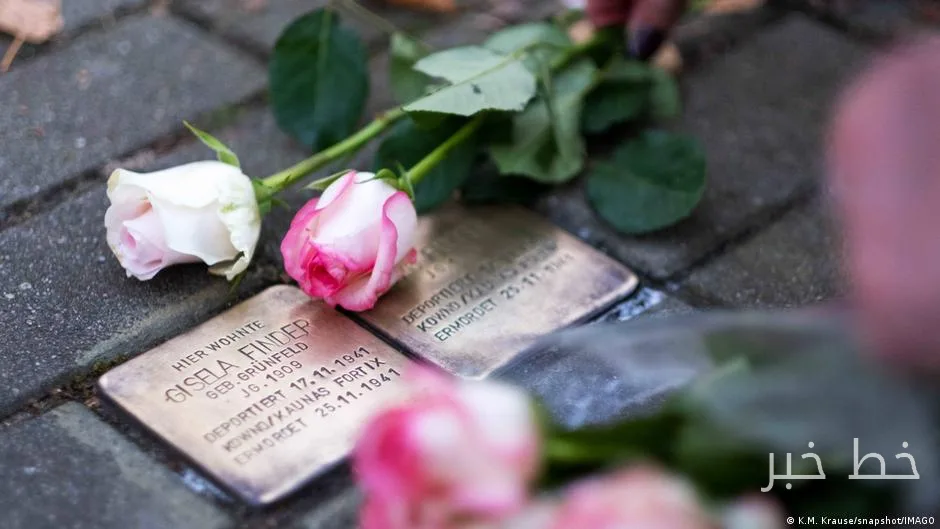
The city of Hoyerswerda, near Dresden, has recently decided to ban the installation of Holocaust memorial stones (Stolpersteine) in public streets. This decision was made following a joint vote by the center-right CDU and the far-right AfD parties, halting the installation of these stones, which bear the names of Holocaust victims.
Details of the Holocaust memorial stones
Holocaust memorial stones are concrete cubes with metal plaques displaying the names of victims. These stones are usually installed in the streets of Germany and are slightly raised above the sidewalk, particularly near homes targeted by the Nazi regime.
Read more: Netanyahu defended Israel at the UN General Assembly
This project was initiated by German artist Gunter Demnig in the early 1990s. While more than 128,000 memorial stones have been installed in Germany, these stones have also been placed in 30 other countries affected by the Nazi regime, making them the largest decentralized memorial in the world.
Reasons for the ban and reactions
Supporters of the ban on installing memorial stones in Hoyerswerda argue that remembering Holocaust victims is a necessary duty, but installing the stones causes passersby to step on the names of the victims. They have suggested that a memorial for Holocaust victims be established in one of the city's cemeteries.
Gunter Demnig, the 78-year-old artist, rejected this argument, stating that remembrance should be visible in places where people once lived, and that the memorial stones make history tangible for local youth. He also referenced the recent state election results in Germany, saying that this ban was predictable.
Demnig criticized the CDU party, saying that it has abandoned Christian values and suggested that perhaps the party should remove the letter "C" from its abbreviation as it has already sidelined Christianity.
Flex Banazak, one of the leaders of the German Green Party, called this action a "scandal" on Friday and referred to ongoing discussions about right-wing extremism and the increasing influence of the AfD. He emphasized that all efforts must be made to keep the memory of those who were persecuted and killed alive.
The International Auschwitz Committee also strongly condemned the CDU's support for this move, describing it as a transparent and hateful attempt to marginalize the victims of the Nazis in Hoyerswerda. Christoph Heibner, the deputy executive of the organization, stated that this action represents efforts to distance the memory of the victims from the city.
Read more: Tensions between Chinese media and American journalists during Xi Jinping's visit · A fighter jet crashed near a US airbase in Spangdahlem, Germany