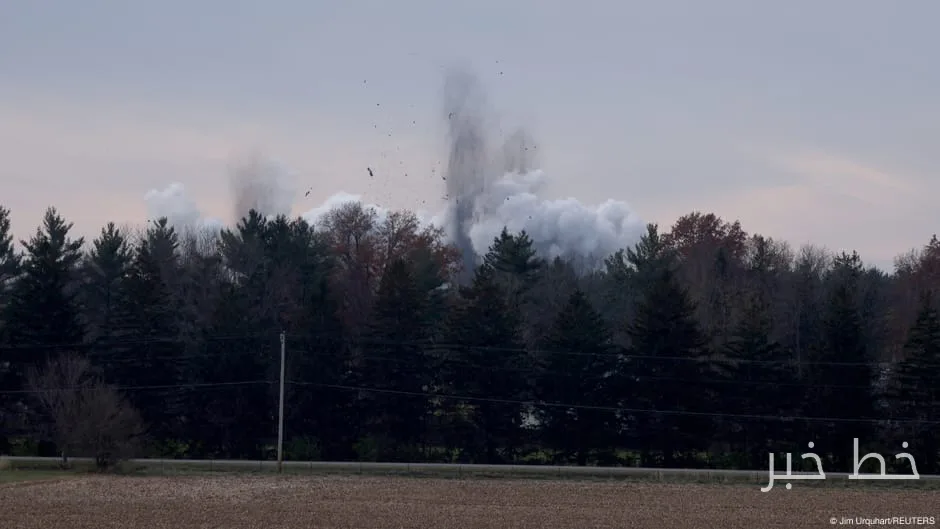
The U.S. Army detonated nearly five tons of unstable explosives containing lead azide at the U.S. Army munitions factory in Midtown Iowa on Wednesday. This action was taken due to the instability of this chemical and its potential hazard for storage.
Details of the Controlled Explosion
The controlled explosion occurred shortly after 9 a.m. local time (1500 GMT) at the U.S. Army munitions factory in Iowa and resulted in the destruction of the nation's entire stockpile of this chemical. After the explosion, plumes of smoke were observed in videos from the explosion site.
Read more: Countries Present at COP31 Failed to Reach Final Agreement
The U.S. Army has stated that residents of a small town and other nearby areas should evacuate "out of caution." Adam Tell, the head of the Department of War, said: "We do not want the public to be in panic. Our goal is to keep these materials at the Iowa munitions factory as much as possible to prevent their transfer."
Hazards and Security Measures
The explosive material was transferred to Iowa from various bases across the country in 2009 for storage. However, an inspection conducted in March revealed that the material had partially crystallized, making it sensitive to friction and cold, which could lead to spontaneous detonation.
General Eric Shelley, the operations commander, said: "Inaction is no longer an option." Rob Chikada, director of the Bureau of Alcohol, Tobacco, Firearms and Explosives, told reporters: "This is not a matter of 'if' but 'when,' and this situation is not a suitable place for us."
To limit toxic lead dust, the Army is constructing barriers around the material storage areas and will use foam and water to trap particles. Estimates suggest that dust may spread up to 40 miles (64 kilometers) southwest, reaching northern Missouri.
Officials expect the wind to carry this smoke away from the city of Burlington, which has a population of nearly 25,000. While residents within a 5-mile (8-kilometer) radius have been asked to evacuate, the Federal Emergency Management Agency has also advised people 5 to 20 miles away to stay indoors and close their windows.
The date of the explosion was changed three times due to public reaction regarding its environmental and public health impacts. A federal appeals court on Monday upheld the plan after environmental groups filed complaints.
Jilly Holler, a farmer and protest organizer, told reporters: "I am not opposed if this is the only safe option." She added: "What I am saying is that this has been so poorly managed that people are confused and do not trust anything they say."
Read more: The Failed COP31 Agreement Revealed a New Reality for Climate Action · The U.S. Army is Set to Detonate Unstable Explosives in Iowa



