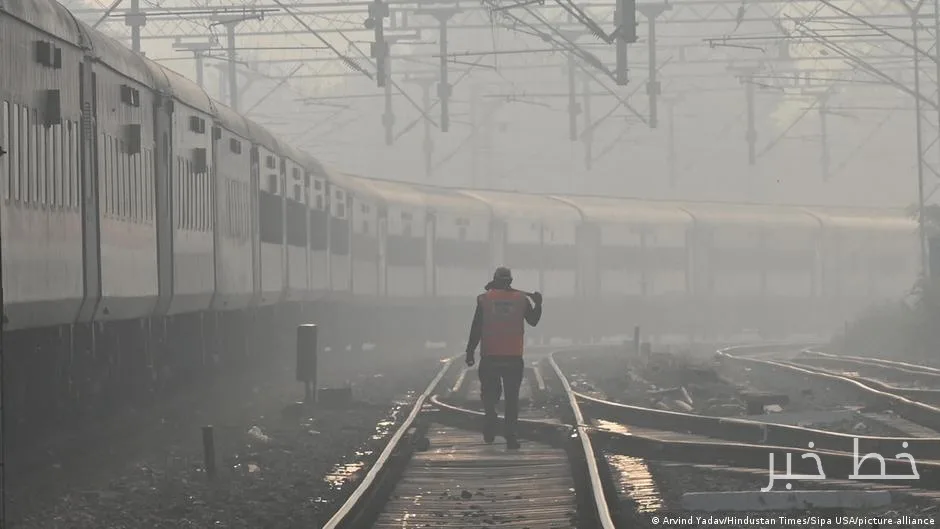
Delhi's air pollution has become a permanent crisis, and the residents of this city are facing serious respiratory problems. Khushboo Aurora, one of the residents of Delhi, is looking to buy an air purifier for her mother, who has health issues. She says: "These days when I wake up, I don't feel fresh, and throughout the day I suffer from headaches and eye irritation."
The Recurring Cycle of Pollution in Delhi
Winter seasons in Delhi increasingly follow a familiar pattern: air quality deteriorates, residents struggle to breathe, and governments exchange blame. Recently, Delhi's air quality reached the "very unhealthy" category, with an average PM2.5 concentration of 157.9 micrograms per cubic meter of air. Meanwhile, the World Health Organization (WHO) recommends a maximum annual concentration of 5 micrograms.
Read more: Germany in Search of Nuclear Waste Disposal Site
Causes of Pollution and Challenges in Mitigation
Delhi is not facing an unknown problem, and there are significant scientific reasons for its air pollution. An assessment in 2026 identified that the main sources of PM2.5 in winter include vehicle emissions, industrial activities, and waste burning. Sunil Dahiya, founder of the environmental group EnviroCatalysts, says: "Delhi is part of a larger air basin, and during winter days, the most pollution enters Delhi."
According to Dahiya, about 65% of PM2.5 in Delhi comes from outside the city, and 35% is generated from internal sources. Coordinated action at the regional level is one of the main challenges. He emphasizes that actions must be taken at the air basin level on an annual and specific basis. Unfortunately, most current measures are seasonal and reactive.
Need for Structural Changes
Dahiya states: "Science is not the barrier; rather, implementation, regional coordination, and political will are the main issues." As long as goals are not linked to reducing emissions from each relevant source and no one is held accountable for achieving them, this problem will persist. Additionally, according to Bhawrin Kandari, one of the founders of Warrior Moms, government responses are more focused on reaction than prevention. She says: "They allow pollution to occur and then try to clean it up."
Delhi's air quality remains at an inappropriate level, and millions of residents cannot afford air purifiers and are exposed to toxic air.
Read more: Efforts to Restore Seagrass Meadows on the Baltic Coast · OpenAI Introduced Data Centers as 'Computing Camps'