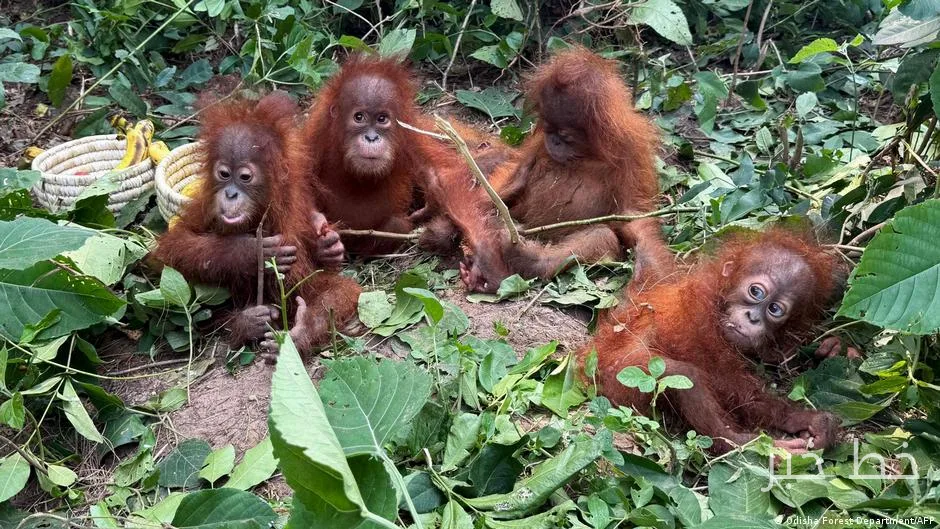
Five baby orangutans, a species found only on the island of Sumatra in Indonesia and Brunei, were discovered last week by park rangers in a forest located in the Balasore district of Odisha, India.
Indonesia's Request for Origin Identification
The Indonesian Ministry of Forestry has asked India to determine where these abandoned orangutans, known for their distinctive red fur, came from and to return them to their original habitat if they have come from outside.
The rescue of these rare monkeys has raised new questions about how exotic animals enter India and the country's involvement in illegal wildlife trade.
Investigation into Trafficking
The Odisha government has requested the Wildlife Crime Control Bureau to investigate how these animals reached the state. Ganesh Ram Singh Khentia, the Minister of Forests and Environment of Odisha, stated, "These animals are not found in India and are mostly seen in the rainforests of Malaysia, Indonesia, Brunei, and Sumatra. We suspect they may have been abandoned by an international wildlife trafficking gang in the forests of the Balasore region."
Orangutans are the latest case in a series of strange wildlife discoveries in India. In November 2024, authorities in Bangalore seized 40 rare animals including giant tortoises, gibbons, and American alligators from a shipment that arrived from Malaysia's capital, Kuala Lumpur. Additionally, in June 2025, Mumbai customs seized 284 exotic animals from four shipments that had come from Thailand's capital, Bangkok.
According to TRAFFIC statistics, between January 2022 and May 2025, 7,272 animals, both alive and dead, were seized in trafficking attempts by travelers on the route from Thailand to India, with over 80% of these cases occurring in India.
Increase in Exotic Animal Trafficking
According to conservation researcher, Uttara Mandiratta, since 2020, the volume of trafficking and the number of species involved in this trade have remarkably increased. She said, "We have found hundreds of species and thousands of individuals being trafficked to India via air and land routes."
Tito Joseph from the Wildlife Conservation Society of India also states that the situation is worsening. He noted that trafficking of exotic species has always existed in India, but has significantly increased since 2018. Joseph has identified routes extending from Myanmar to other parts of the country and also mentioned movement from Bangladesh to India.
Recent analyses indicate that the demand for ownership of exotic animals and illegal digital markets is on the rise. This, according to Roy Chalam, a biologist and conservation researcher, has contributed to the growth of wildlife trafficking. He added, "International social platforms have facilitated the growth of illegal wildlife trade as an online market."
Pinpointing the exact location of animal entry after crossing several borders is a challenging task. Trishala Ashok, a conservation filmmaker, emphasized that the discovery of animals cannot be the end of investigations, and the networks of traffickers, suppliers, and buyers must be pursued. She said, "Unless we follow these links, we will only seize shipments and not dismantle the networks behind them."