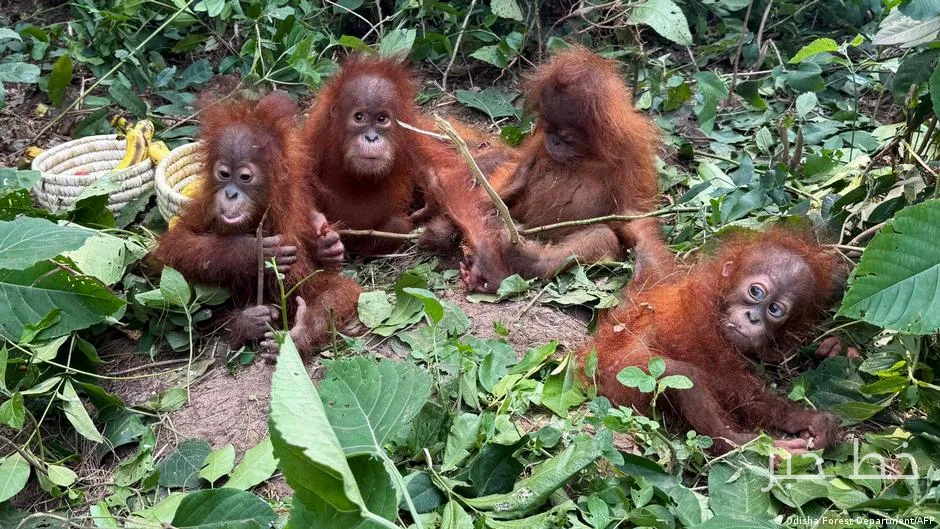
Five baby orangutans, a species found only on the island of Sumatra in Indonesia and Borneo, were discovered last week by forest guards in the Balasore region of Odisha state in eastern India.
Indonesia's Request for the Return of the Orangutans
The Indonesian Ministry of Forestry has asked India to identify the source of these abandoned orangutans and, if confirmed that these animals have been taken from their original habitat, to return them to their country. This rare discovery has raised new questions about how non-native animals enter India and the country's involvement in illegal wildlife trade.
Increase in Wildlife Trafficking
Kanita Krishnasamy, regional director of the wildlife trade monitoring network TRAFFIC, said: "The discovery of these orangutans on the eastern coast of India is somewhat strange. It's like when live kangaroos were found on the highways of West Bengal a few years ago." She also asked: "Why are the orangutans in India? Were they trafficked from Malaysia or Indonesia, or did they come from a facility?"
The Odisha government has requested the Wildlife Crime Control Bureau to investigate how these endangered animals arrived in the state. Ganesh Ram Singh Khentia, Odisha's Minister of Forests and Environment, stated: "These animals are not found in India and are primarily seen in the rainforests of Malaysia, Indonesia, Borneo, and Sumatra in Southeast Asia."
Khentia pointed to the possibility that these animals were released into the forests of the Balasore region by an international trafficking gang. The orangutans are the latest example of exotic animals discovered in India. In November 2024, authorities in Bangalore seized 40 rare animals that had entered from Malaysia's capital, Kuala Lumpur. These animals included Aldabra giant tortoises, gibbons, American alligators, and iguanas.
Statistics on Animal Trafficking to India
In June 2025, Mumbai Customs seized 284 non-native animals that had arrived in four shipments from Thailand's capital, Bangkok. Additionally, in July 2025, customs officials in Pune seized 20 non-native animals from incoming travelers from Bangkok, including 14 green pythons, four lovebirds, and two striped Sumatran rabbits.
According to TRAFFIC's statistics, 7,272 live and dead animals have been seized in trafficking efforts between Thailand and India from January 2022 to May 2025, with over 80% of these seizures occurring in India. These animals included reptiles, birds, and mammals, many of which appear to be intended for the exotic pet trade.
Outara Mandirata, a conservation researcher and expert, stated: "We have found hundreds of species and thousands of individuals being trafficked illegally into India. Since around 2020, the volume of this trafficking and the number of species involved have significantly increased." TRAFFIC also noted that India and Malaysia played the largest roles in an illegal gibbon trade chain in 2025.
Tito Joseph from the Wildlife Protection Society of India says the situation is severely escalating. He emphasized that the trafficking of non-native species has always existed in India, but has significantly increased since 2018. He has identified trafficking routes from Myanmar through northeastern India as well as movement from Bangladesh to India.
Demand for non-native animals is rising, and unregulated digital markets are exacerbating the issue. Analyses conducted in June 2026 show that social media has facilitated the growth of illegal wildlife trade and provided a platform for showcasing and selling these animals.
Ashok, a conservation filmmaker, said: "Investigating the source of animals after crossing multiple borders can be particularly challenging. Seizures should not be the end of the investigation, but rather the beginning of it."