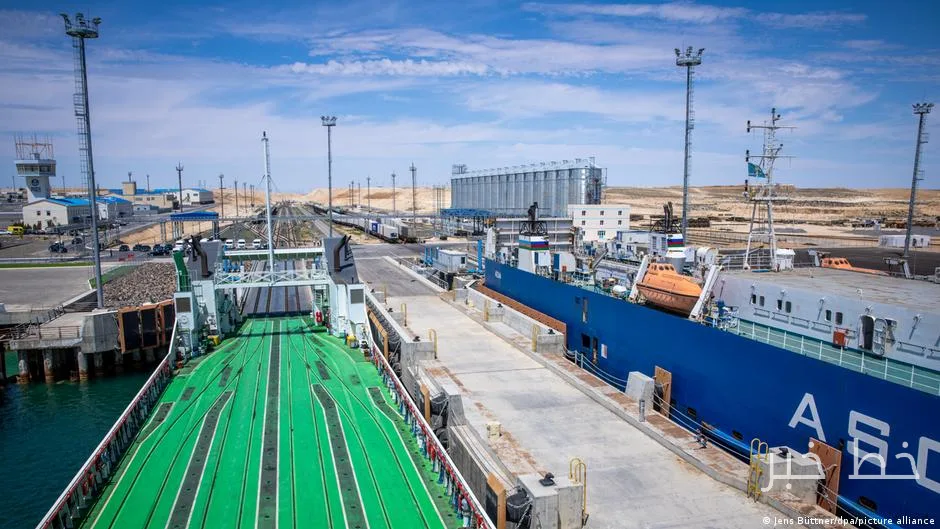
Drone attacks on two commercial ships off the coast of Bulgaria on October 6 sank one of the ships and sparked concern and anger in Bulgaria and the European Union. These attacks come at a time when the European Union is looking to turn Bulgaria into a key entry point for imported goods from Asia via the Middle Corridor.
The Middle Corridor and Its Importance
The Middle Corridor, which the European Union refers to as the Trans-Caspian transport corridor, connects Europe and Asia. This corridor starts in China and reaches the European Union through Kazakhstan, Azerbaijan, Georgia, and Turkey. Although it mainly consists of railways and roads, short sections of it cross the Black Sea and the Caspian Sea.
The European Union has announced this year that it intends to make significant investments in this route, which could have implications for the railways, roads, and ports of Bulgaria. The land border crossing between Bulgaria and Turkey, Captain Andreeva, is one of the busiest crossings in Europe.
Challenges of the Middle Corridor
Despite the attractions of the Middle Corridor, challenges such as security restrictions and institutional weaknesses in the countries along this route exist. The security situation in Central Asia needs to improve to make long-term planning for large projects feasible. Additionally, recent attacks on ships in the Black Sea remind us that security along this route can still be problematic.
Furthermore, the declining water levels in the Caspian Sea due to climate change could lead to issues for ship passage. The ports and railways along this route are also in dire need of investment to increase trade capacity.
However, the European Union remains keen to increase trade through the Middle Corridor. The President of the European Commission, Ursula von der Leyen, in her recent State of the Union address, emphasized the need to improve "connectivity" and diversify trade routes. To this end, there is a goal of raising €12 billion in public and private investment.
Bulgaria could benefit from these investments in various ways. Improving rail and port infrastructure, especially in the northern part of the country where connectivity is weaker, could bring significant advantages to the country.