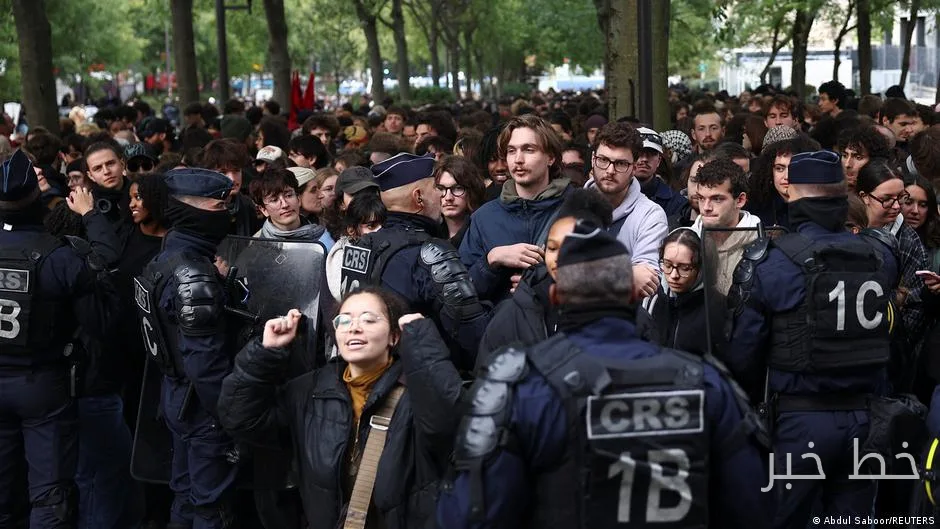
France will deploy 70,000 police forces across the country to control new protests scheduled for Saturday. Laurent Nunez, the interior minister, warned about the spread of online invitations for violence and theft, stating that police forces will deal firmly with individuals who engage in rioting and vandalism.
Deployment of Police Forces and Special Equipment
Nunez told reporters, "We will not hesitate in dealing with rioters, thieves, and anyone who engages in violence." Regular police forces will be reinforced with special units, mounted police, and heavy vehicles, and will also be equipped with helicopters, water cannons, drones, and anti-drone systems. He added that "we will be extremely vigilant" and committed to "not overlooking anything."
Read more: French authorities imposed partial curfews in Paris and Nice
Outbreak of Violence in Recent Protests
This show of force comes a week after riots erupted in Paris and other major cities. While the political crisis began with students' demands for improved educational facilities, it gradually transformed into public anger over the cost of living. Last Saturday, protests turned into violent riots, and officials accused extremist groups and young theft gangs of exploiting the protesters' anger and causing chaos.
Police forces faced masked theft groups setting cars and buildings on fire, and thousands of stores were vandalized. Nunez, the interior minister, stated on Friday that this insecurity is "completely unacceptable" and that officials will "do everything they can" to prevent a recurrence of this violence.
Meanwhile, Parisian vendors were covering their shop windows, and the city council urged residents and business owners to remove items that could be set on fire or used as projectiles or barricades.
Nunez also announced that officials will maintain nighttime restrictions in specific areas of the city. This includes restrictions between 11 PM and 6 AM in two central squares in Paris. The police have only approved one protest march organized by the CGT labor union along a limited route in Paris and rejected requests from France's largest student union (UNEF) and the Yellow Vests movement to hold their gatherings.
The government led by Emmanuel Macron, the centrist president, is trying to distinguish between what they see as legitimate protests and violent insecurities. Macron also dismissed narratives about the role of Islamic extremists and immigrants in inciting violence but accused far-left groups of attempting to stage a coup.
On Friday, Macron also held his first meeting with representatives of high school students. However, this meeting ended with students' demands for more protests. Nathaniel Kumbari, a student representative and head of the "High School Modernization" campaign group, stated that "we are not satisfied" and said that "students are still waiting for specific proposals" to be presented in a meeting with the prime minister on Monday.
He urged his classmates to "continue their activism" and "maintain their resistance" against the government.
Read more: The European Union introduced a new policy for the Arctic · Netanyahu ordered the demolition of homes after Israeli soldiers were killed