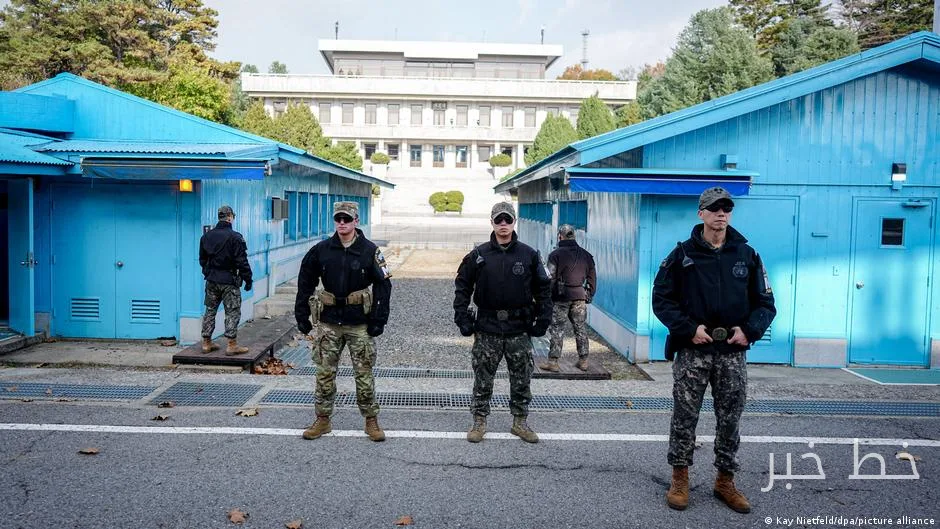
Friedrich Merz, the German Chancellor, expressed a wish for unity for the Korean people during a visit to the Demilitarized Zone (DMZ) that separates the two Koreas. Referring to Germany's historical experiences with division and unity, he said: "We Germans know how painful it is to divide a country." Merz also highlighted the importance of dialogue and resilience in values, adding: "We wish for the Korean people unity in freedom."
History of the Division of Korea
The history of the two Koreas, North and South, is closely linked to Germany's history during its division and unity. Germany peacefully reunited in 1991, but 35 years after this event, South Korea and North Korea still face deep political and economic differences and opposing governmental systems. Meanwhile, the sentiments of younger generations in South Korea towards North Korea have changed, with many viewing it as a threatening foreign country.
Read more: Diplomacy as a Tool for Maintaining Peace and Managing International Relations
Obstacles to Unity
According to a recent study, 39.1% of South Koreans believe that unity is impossible. This concern is particularly due to the high costs of developing North Korea's infrastructure. The South Korean government has officially maintained unity as a national goal, but the willingness to promote this idea has diminished in recent administrations. In contrast, North Korea has clearly changed its stance, and in December 2023, Kim Jong Un declared that peaceful unity is no longer possible and that South Korea is regarded as a hostile rival.
Changes to North Korea's constitution, approved in March 2026, indicate the regime's unwillingness to approach South Korea. Additionally, analysts and ordinary people in South Korea respond with skepticism regarding the issue of Korean unity.
Besides the unwillingness of both sides, there are other challenges. The North Korean regime seeks to maintain its power and legitimacy, which is jeopardized by the introduction of a democratic system in a unified country. Furthermore, the economic gap between the two countries is vast, with North Korea's GDP at only $31.7 billion per year, while South Korea's figure stands at $1.85 trillion.
Ultimately, Korean unity is not just an internal issue; it also involves strategic and security considerations. South Korea is dependent on the United States, while North Korea relies on China and Russia, and these superpowers are reluctant to lose their allies in the event of unity. Therefore, the current situation may be the best way to maintain regional stability, although economic and social conditions may change significantly in the future.
Read more: Kallas Considered Putin's Return to the G20 Summit Dangerous · North Korean Hacking Group Linked to $6.3 Billion Binance Theft