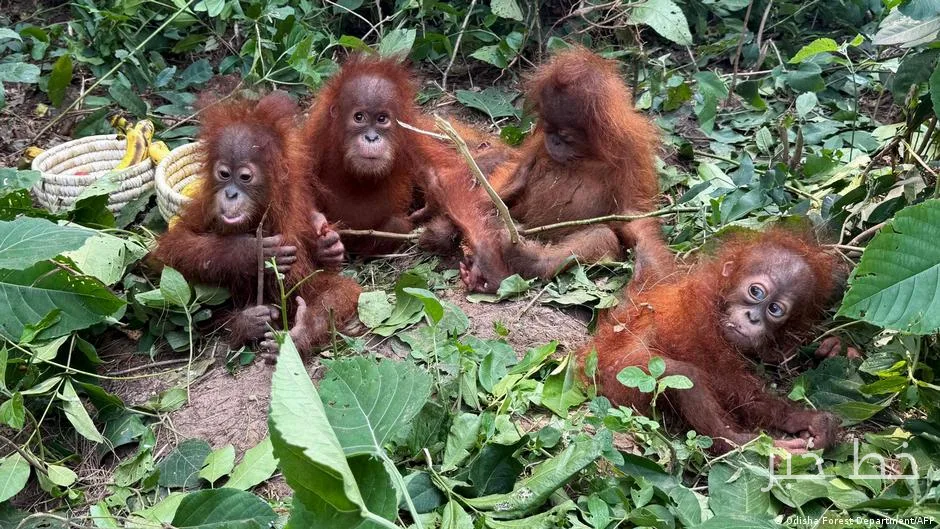
Five baby orangutans, a unique species found only on the islands of Sumatra and Borneo in Indonesia, were discovered last week in a forest in the Balasore region of Odisha, India, by forest rangers.
Indonesia's Request for Investigation into the Source of the Orangutans
The Indonesian Ministry of Forestry has requested India to identify the source of these abandoned orangutans and to return them if it is proven that they came from their natural habitat abroad.
Read more: The European Space Agency Launched Two Weather Surveillance Satellites into Space
The rescue of these rare monkeys has raised new questions about how exotic animals enter India and the country's role in illegal wildlife trade. Kanita Krishnasamy, regional director of the wildlife trade monitoring network TRAFFIC, called this discovery "strange" and expressed concern that these orangutans may have been trafficked from Malaysia or Indonesia.
Investigations into the Entry of Orangutans into India
The Odisha government has requested the Wildlife Crime Control Bureau to investigate how these endangered animals entered the state. Ganesh Ram Singh Khentia, Odisha's Minister of Forest and Environment, stated that these animals are not found in India and are primarily observed in the rainforests of Malaysia, Indonesia, and Borneo.
Orangutans are the latest case of exotic animals discovered in India. In November 2024, officials in Bangalore seized 40 rare animals that were coming from Kuala Lumpur. In June 2025, Mumbai Customs confiscated 284 exotic animals that were arriving from Bangkok.
According to TRAFFIC statistics, between January 2022 and May 2025, 7,272 live and dead animals were seized in trafficking attempts from Thailand to India, with over 80% of these cases occurring in India.
Outre Mandirata, a conservation researcher, stated that the scale of this trafficking and the diversity of species involved have increased, and this situation has significantly changed since 2020. He also noted that some traders who were active in the trafficking of live animals have now also engaged in supplying other exotic wildlife.
This situation has been exacerbated by the growing interest in owning exotic animals and illegal digital marketplaces. Rivi Chala, a biologist and conservation scientist, said that social media platforms have facilitated the growth of illegal wildlife trade and act as an online marketplace for this trade.
Identifying the source of animals after crossing several borders can be very difficult. Tito Joel, a representative of the Wildlife Conservation Society of India, warned that the trafficking of exotic species has always existed in India and has significantly increased since 2018.
Read more: A "Monster" Fire on Brač Island, Croatia, Homes at Risk! · The Discovery of Five Baby Orangutans in a Forest in India Indicates Animal Trafficking